How a private equity firm rolls out AI across its portfolio companies
Most firms either mandate AI everywhere at once or leave each company to work it out alone. The rollouts that work set shared rules, improve one decision at one company, then carry what worked to the next.
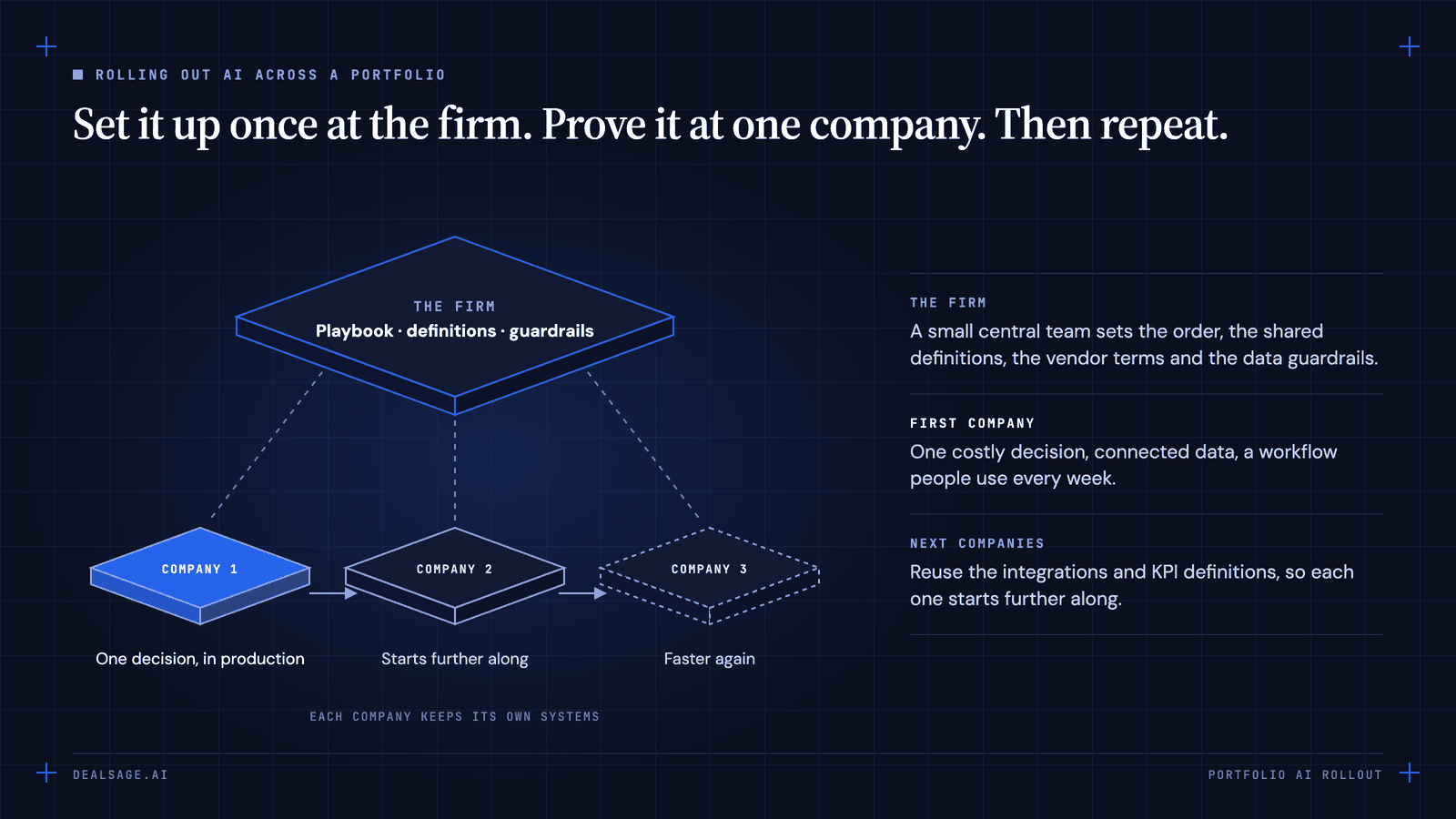
A private equity firm rolls out AI across its portfolio in three moves. A small team at the firm sets shared rules for data, vendor terms, KPI definitions and measuring value. One portfolio company then puts a workflow into production to improve a costly decision. The firm carries the integrations, definitions and lessons to the next company. Each one starts further along than the last.
Most rollouts take a different path. The firm mandates AI everywhere at once and tends to end up with licenses and pilots. Or it leaves each company to work it out alone. Each business ends up with different tools, and the firm has nothing it can reuse. Bain’s survey of private investors with $3.2 trillion in assets found that most portfolio companies were testing generative AI, but only about one in five (nearly 20%) had use cases operating with concrete results (Bain, 2025).
This guide covers who runs the rollout, what the firm sets up first, which company goes first, what carries over and how to measure results. For the wider picture of AI in deal work, see AI for investment firms.
Who runs AI across a portfolio: the firm or each company?
Both, with a clear split. The firm should own what has to be the same everywhere. The company should own the workflows, because its managers are the ones who have to use them every week.
Large sponsors differ in how much work they handle centrally. Bain’s 2025 report describes three of them, and 2026 added a fourth.
| Sponsor | How it organizes AI across the portfolio |
|---|---|
 Vista Equity Partners |
An in-house team of AI engineers that builds with portfolio companies, plus hackathons and peer forums. Bain reports Vista asks each company to submit goals and quantified benefits for its generative AI work |
 Apollo |
A center of excellence to speed up adoption across the portfolio, staffed with two partners and an advisory board of outside AI experts (per Bain) |
 Hg |
Relies on portfolio management teams sharing ideas with each other rather than a firm-level AI team (per Bain) |
 Ode (Blackstone, Hellman & Friedman, Goldman Sachs and Anthropic) |
Blackstone, Hellman & Friedman and Goldman Sachs are founding partners of this AI services company with Anthropic, announced May 4, 2026, to work with mid-sized companies across sectors |
 OpenAI Deployment Company (TPG, Advent, Bain Capital and Brookfield) |
TPG, Advent, Bain Capital and Brookfield are the lead backers, reported in May 2026 with more than $4 billion in initial funding from 19 firms |
Sources: Bain, Vista, Anthropic, The Next Web.
Vista’s own page puts the logic plainly: “what we learn in one company, we apply to another.” Vista is a software investor with more than 85 companies, so a standing engineering team pays for itself. A mid-market firm with eight or twelve companies in industrial services, distribution or healthcare faces a different problem. It rarely has engineers of its own, and its companies have less in common. That firm still needs shared rules. It usually brings in engineers from a partner or one of the new deployment firms.
What should the firm set up before the first company starts?
The firm needs less setup than most expect. Settle four things centrally before anyone buys a tool:
- Guardrails. Which data can go where, which models and vendors are approved, how access is controlled and what gets logged. Left to themselves, companies will set different rules.
- Vendor and model terms. One negotiation instead of twelve. Vista says it secures engineering support, early access to models and preferred compute pricing for its companies. Smaller firms can still agree on common terms with the vendors they use.
- Shared definitions. What counts as gross margin, utilization, churn or a billable job. If each company defines these once, in one place, the firm’s portfolio monitoring improves too.
- A way to estimate value. A short template that asks what decision changes, what it is worth and how the result will be measured. This is what Vista’s requirement for quantified benefits amounts to. It keeps the program from becoming a list of demos.
Each company should choose its own workflows. A deal team in New York cannot tell a field services company which billing problem matters most. The company’s CFO can.
Which portfolio company should go first?
Choose the first company carefully. Its work shapes every rollout that follows. The best candidates share four traits:
- A costly recurring decision. Billing accuracy, contract pricing, crew scheduling, inventory, the month-end close. Something that happens every week or month and costs money when it goes wrong.
- A CEO or CFO who wants the work done. A mandate alone will not do. Engineers need people who can explain exceptions and decide how the workflow should run.
- Accessible data. The systems do not have to be clean, but someone has to be able to grant access to them.
- Time before exit. A company in a sale process has no room for a new project, and the buyer gets the benefit.
Two other traits help. If the company uses the same ERP, accounting or field operations software as others in the portfolio, its integrations can be reused. A team that is not dealing with a crisis also has more time for the work.
What does the work look like at the first company?
It follows the same four steps as any single-company implementation: connect the systems, bring the data into one model of the business, implement the workflow, and use it to improve the decision. Our guide to forward-deployed engineering covers each step in detail.
With one PE-backed field services company, that meant connecting the data warehouse, finance, billing, HR and every customer contract. We estimated the value by area of the business and used the numbers to decide what to build. A contract review app found accounts where billing had drifted from the agreed pricing. A crew productivity view gave operations and finance the same numbers. Finance reporting ran from the model, and an agent prepared the weekly operations review before the leadership meeting.
For the sponsor, the lasting value was the model of the business. The company could build its next workflow on it, and the sponsor could read the same KPIs.
How does the rollout move to the second and third company?
Reuse what works across companies. Rebuild only what each business needs to do differently. Three things usually carry over:
- Integrations. If the second company runs the same accounting or ERP system, the connection already exists.
- Definitions. KPI definitions, data rules and the value template are already agreed.
- The playbook. How to scope a workflow, test it with users and decide when it is ready. That includes what went wrong the first time.
The specific workflow does not carry over when the businesses differ. A distributor’s problem is rarely a field services company’s problem. A distributor might need to see which accounts are profitable once freight, rebates and returns are counted. The steps are the same. The decision is different.
The order matters. A firm that starts at five companies at once builds five sets of integrations and definitions in parallel. It learns the same lessons five times and has nothing proven to show the sixth. A firm that starts at one can reuse that work at the second company.
How should a firm measure whether portfolio AI is working?
Record a baseline before building. Then track two things at each company against it.
Adoption. Do people use the workflow when the task comes around, and act on what it says? If the controller still keeps the old spreadsheet, find out why.
One business outcome. Revenue recovered from billing errors, days taken off the close, fewer quality incidents, better crew utilization. Count the cost of review time and running the system too.
Be careful with self-reported success. FTI Consulting’s 2026 survey of 200 fund and operating leaders found 95% of funds reported AI initiatives meeting or exceeding their original business case (FTI Consulting). That is hard to square with Bain’s finding that nearly 20% of portfolio companies had use cases operating with concrete results. Both can be true if the business cases were modest. The only defense is a baseline and a result the CFO agrees with.
Measure from the same data the sponsor uses for portfolio monitoring. Read the outcome from the company’s model so the board pack and the AI program update show the same result. For the baseline, the ledger of confirmed dollars and the board page itself, see how do we prove AI ROI to our board and sponsor?
What goes wrong in portfolio AI rollouts?
Four problems keep coming up.
Licenses as a rollout. Every company gets a chat assistant and the firm reports adoption. People get faster at their own tasks, but company output stays flat. The reasons are covered in why AI rollouts don’t raise company productivity.
Pilots with no owner for production. A demo works, the consultant leaves, and nobody at the company is responsible for running it. Before building, agree on who will own the workflow after launch.
A different tool at every company. Each CEO picks a vendor. Nothing carries over, and the firm cannot compare results.
Not enough people. In the FTI survey, talent was the main constraint on scaling adoption, cited by 35% of respondents. Most mid-market companies and PE firms have no engineers to spare. That is the gap the new deployment firms and embedded partners are trying to fill.
When is a portfolio-wide rollout the wrong choice?
Sometimes a smaller project makes more sense.
- The portfolio is small and the companies have nothing in common. With three businesses in unrelated sectors running different systems, little carries over. Treat each as its own project and skip the central program, apart from the guardrails.
- The firm has no one to run it. Someone at the firm needs to own the rollout, even part-time. Without that owner, help individual companies instead.
- A standard tool already fits. Expense management, meeting notes and basic reporting are well served by off-the-shelf software. The value of improving a decision must justify the cost of custom engineering.
- The company is about to be sold. Start the work at companies with a long hold period ahead of them.
Does this only work for PE-backed companies?
No. The same order works inside one mid-market company with no sponsor: pick a costly decision, connect the data it needs, get one workflow into production, then build the next one on the same model of the business. A sponsor can carry that work between companies and track results across the portfolio. For how a single company picks that first decision and what its first 90 days look like, see where should a mid-market company start with AI?
How DealSage helps firms and their portfolio companies
DealSage connects a company’s systems and brings their data into one model of the business. We build workflows, agents and apps on that model. Our engineers stay embedded until the work runs in production. For an investment firm, the model can connect its view of the portfolio to each company’s systems and weekly work. The integrations and definitions built at one company can then carry over to the next. We also work with firms and mid-market companies on their own.
DealSage was built by alumni of J.P. Morgan and Palantir. If you are deciding which portfolio company should go first, or how to stop a rollout from turning into twelve separate pilots, talk to us. We start with one decision and what improving it would be worth.
Frequently asked questions
- How do private equity firms roll out AI across their portfolio companies?
- Most successful rollouts follow the same order. The firm sets up a small central team to agree on shared guardrails, vendor terms and KPI definitions. It also creates a template for estimating the value of each use case. It picks one portfolio company with a costly recurring decision and gets one workflow into production there. It then carries the integrations, definitions and lessons to the next company. Mandating the same tools everywhere at once usually produces licenses and pilots rather than results.
- Should a PE firm build a central AI team or let each portfolio company lead?
- Usually both, with a clear split. The firm owns what should be the same everywhere: data and security guardrails, vendor and model terms, KPI definitions and how value is measured. Each company owns its workflows, because its CEO and managers are the ones who have to use them. Large sponsors such as Vista and Apollo built central teams; Hg has relied on portfolio management teams sharing ideas. Smaller firms often use an outside partner for this work.
- Which portfolio company should go first with AI?
- Pick a company with a recurring decision that costs real money when it goes wrong (billing accuracy, pricing, scheduling, the month-end close), a CEO or CFO who wants the work done, data the team can access, and no sale planned in the next year. Ideally it runs systems common across the portfolio, so the integrations can be reused.
- How long does it take to roll out AI across a PE portfolio?
- It depends on the number of companies, how different they are and the state of their data. The first company takes longest because the guardrails, integrations and definitions are new. Later companies go faster when they reuse that work. Plan around production milestones per company rather than a single portfolio-wide date.
- How should a PE firm measure the ROI of AI in its portfolio companies?
- Agree on one business outcome per company before building. It could be revenue recovered from billing errors, days taken off the close or crew utilization. Record a baseline. Then track whether people use the workflow when the task comes around and measure the outcome against that baseline. Include the cost of review time and running the system. Read both from the same data the sponsor already uses for portfolio monitoring.
- What are the biggest mistakes PE firms make rolling out AI?
- Buying licenses for every company and calling it a rollout, running pilots with no owner for production, letting each company pick different tools so nothing carries over, and starting a big program on data nobody has cleaned. In FTI Consulting's 2026 survey of 200 fund and operating leaders, talent was the main constraint on scaling, cited by 35%.
- Does a company need private equity backing to run AI this way?
- No. The same sequence works inside a single mid-market company with no sponsor: pick one costly decision, connect the data it needs, get a workflow into production, then build the next one on the same model. In a portfolio, the sponsor carries that work between companies.
See it on your own deals.
We build AI on your firm's own record, then embed it in the workflow your team already runs. Start with one process.