
Where should a mid-market company start with AI?
Start with one weekly decision that costs real money when it goes wrong. Use data you already have, give it an owner and measure the result.
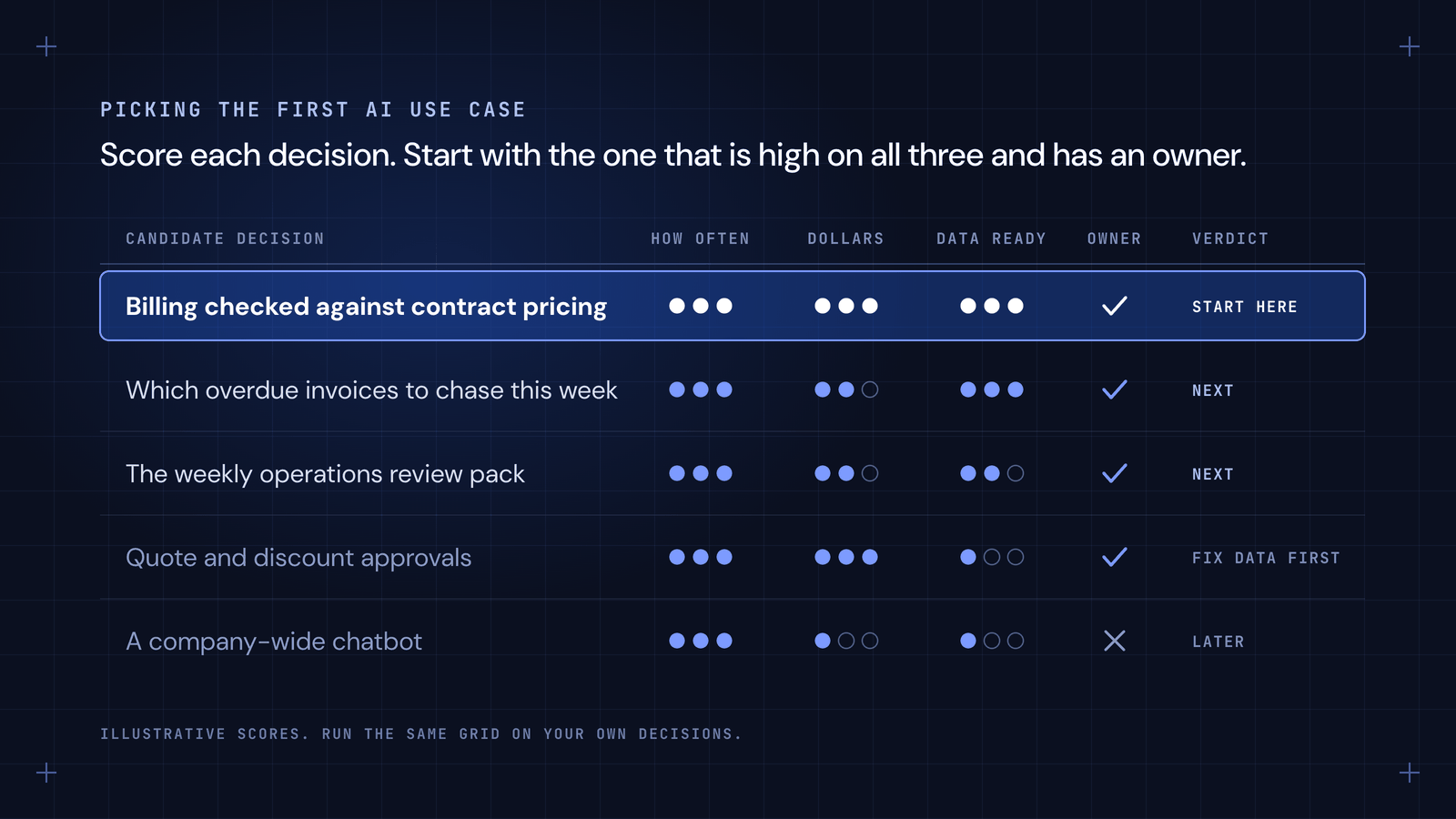
A mid-market company should start its AI work with one weekly decision that costs real money when it goes wrong, not with a tool, a chatbot or a data project. Choose a decision that runs on data you already hold, give it one owner, and aim to have an AI workflow feeding it in the weekly meeting within about 90 days.
CEOs and CFOs of $20M to $500M companies face board pressure for an AI plan; sponsors face it across a portfolio. Licenses, chatbots, data platforms and strategy decks all sound sensible. Which will change a number the board tracks?
Are mid-market companies already using AI, and is it paying off?
Using AI and earning a measurable return from it are different tests.
 RSM Middle Market AI Survey 2026, July 21, 2026: 86% had partly or fully integrated AI; 97% were satisfied; 54% exceeded ROI expectations. Its 1,030 US and Canadian respondents, surveyed March 5 to 16, 2026, all already used AI.
- RSM, July 2026: 58% planned to invest $1 million or more that fiscal year. 45% prioritized “implementing AI where it delivers clear value today,” versus 17% pursuing enterprise transformation.
- RSM, July 2026: 34% named data quality and availability as a deployment inhibitor, the leading obstacle. Among respondents with moderate or limited pilot success, scaling barriers were data quality (53%), integration (47%) and unclear ROI (33%).
 BCG, “The Widening AI Value Gap,” September 30, 2025: 5% qualified as “future-built,” achieving AI value at scale; 60% reported minimal revenue and cost gains. BCG surveyed 1,250 senior executives and AI decision makers.
 MIT NANDA, “The GenAI Divide: State of AI in Business 2025,” reported by Fortune, August 18, 2025: for 95% of companies in the dataset, generative AI implementation was falling short. “The 95% failure rate for enterprise AI solutions represents the clearest manifestation of the GenAI Divide,” the report states. The research covered 150 leadership interviews, 350 employee survey responses and 300 public AI deployments.
How can 97% be satisfied while 95% fall short? RSM asks companies already using AI whether they are happy with it and whether their pilots worked. BCG and MIT ask whether AI moved revenue or cost for the whole company. A pilot that worked and a P&L that moved are different tests. Our read is that many companies have passed the first test without trying the second, because their first use case was a tool rather than a decision.
What is the difference between an AI tool, a pilot and a decision in production?
Pick the decision first, then work backward to the AI and data it needs.
| Term | What it means | What it proves |
|---|---|---|
| A license (a seat on Copilot or ChatGPT) | People can use AI for their own tasks | People will try it |
| A pilot | One workflow tested on sample data or a small team, usually with the vendor driving | It can work |
| A use case in production | Runs on live data, every time the task comes up, with someone accountable for it | It keeps working |
| A decision run on AI | The weekly or monthly call (re-bill this account, chase these invoices, staff this job) is made from what the AI flags, and the result is measured | It is worth money |
How do you pick the first AI use case?
Score frequency, dollars at stake and available data, then require an owner. We call it the first-decision score. The grid at the top of the page runs it on five common candidates.
| Test | The question | Scores high when |
|---|---|---|
| How often | How often does the business make this call? | Weekly or more, so the AI gets used and the gains add up |
| Dollars at stake | What does one wrong call cost, times how often it happens? | You can put a dollar range on it that the CFO accepts |
| Data you already have | Does the data sit in systems you run today? | ERP, accounting, CRM, billing, contracts or scheduling already hold it |
| Owner | Who makes this decision and will act on what the AI flags? | One named person, with the authority to change how it is done |
Candidates include billing against contract pricing, overdue invoices, the weekly operations review, quote and discount approvals, month-end close commentary, and scheduling and capacity. AI reads contracts and invoices to flag billing errors, ranks overdue invoices by likely recovery, drafts the review before Monday or flags discounts outside policy. Humans make the call.
MIT NANDA, via Fortune in August 2025, found more than half of generative AI budgets went to sales and marketing tools, while back-office automation produced the biggest ROI. BCG, September 2025, placed 70% of AI’s potential value in core business functions.
At a PE-backed field services company, we connected the data warehouse, finance, billing, HR and every customer contract, then sized opportunities and built in that order. First came a contract review app that found billing drifting from agreed pricing. A crew productivity view, finance reporting from the model and an agent preparing the weekly operations review followed. See the forward-deployed engineering example.
What should you leave until later?
Defer work that needs more data, trust or organizational change than the first decision.
- Company-wide assistants: cheap to try alongside the main work, but hard to tie to a company number.
- Customer-facing agents: prove the internal decision first; customer-facing mistakes cost more.
- A warehouse or data lake rebuild: connect what this decision needs, then widen it.
- Forecasting with thin history or conflicting definitions: follow the grid’s “fix data first” row.
- Five simultaneous pilots: each needs an owner, data and a baseline. Start with one.
What do the first 90 days look like?
Plan to connect, test and run one AI workflow in the weekly meeting within 90 days.
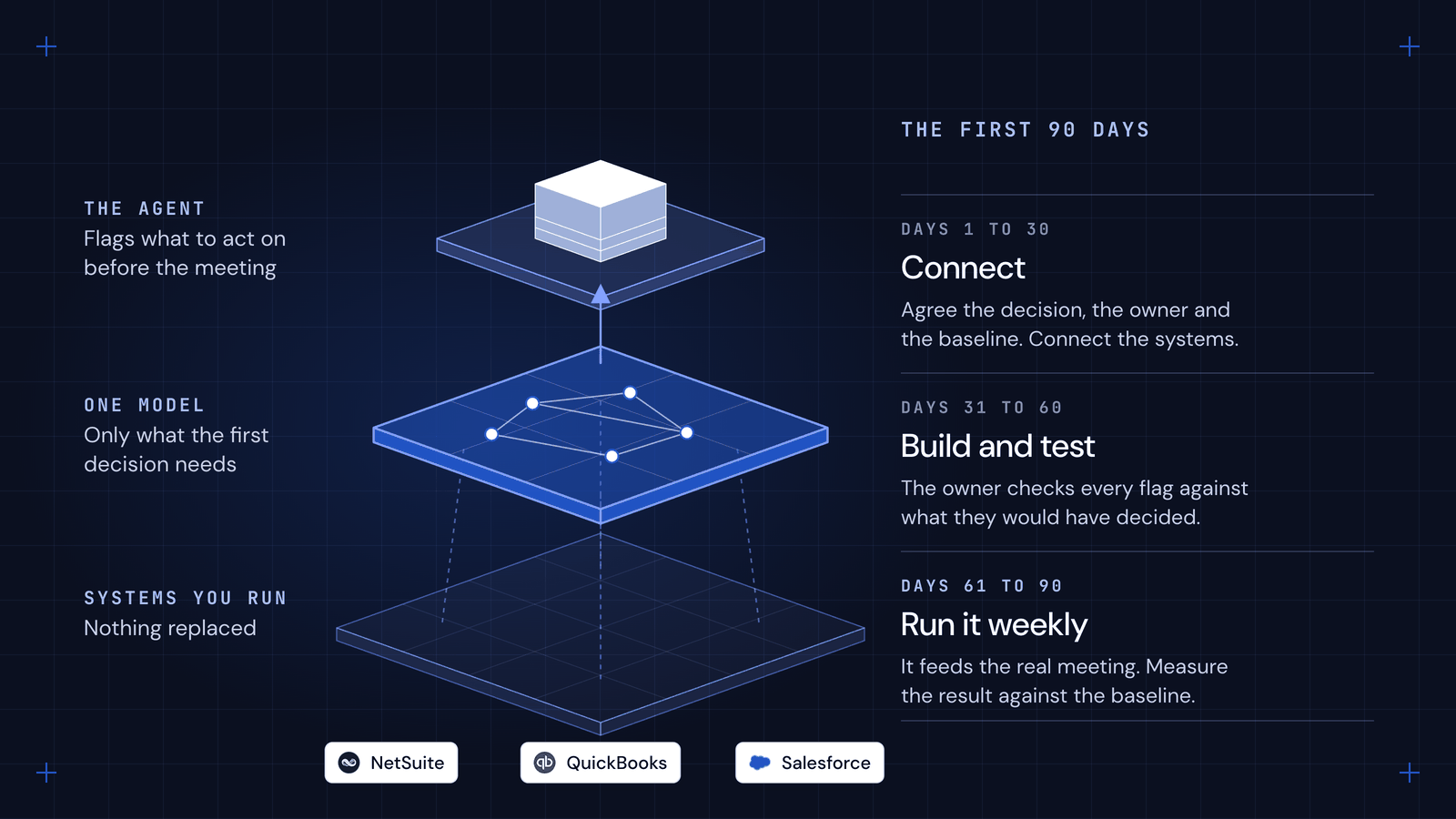
Days 1 to 30: agree the decision, owner and baseline. For billing, use revenue lost to off-contract pricing last quarter. Connect existing systems without replacing them. Bring only the needed records, such as customers, contracts and invoices, into one model of the business.
Days 31 to 60: build and test. AI reads, matches and flags; the agent prepares the list or draft. The owner checks every flag against their own judgment, and the team tightens rules where it is wrong.
Days 61 to 90: use it in the weekly meeting. Measure whether people use it and whether results improve against the baseline. Include review time and running costs.
After day 90, reuse the connections and model for the next decision so it goes faster. See how a private equity firm rolls out AI across its portfolio.
What are the common false starts?
Four starts feel like progress and postpone the result.
- Seat licenses as the strategy. People write emails faster, but the work still waits between teams, so the company number stays flat. See why AI rollouts don’t raise company productivity.
- A data lake first. A year goes into centralizing everything before anyone uses it. Data quality is a real obstacle: RSM’s 2026 survey ranks it the top inhibitor (34%), and the top scaling barrier (53%) for companies with weaker pilots. The answer is to scope the data to one decision, not to postpone AI until all of it is clean.
- A pilot with no owner. A vendor or consultant runs a demo, it works, they leave, and nobody runs it. Name the owner before anything is built.
- Spending where it is easiest to buy. MIT NANDA found more than half of generative AI budgets going to sales and marketing tools, while the biggest returns came from the back office.
When is this the wrong place to start?
Buy when a product fits; wait when nobody can own the decision or the company is about to change hands.
| Option | Best for | Not enough when |
|---|---|---|
 Microsoft 365 Copilot or  ChatGPT Enterprise |
Drafting, summarizing and search for individuals | You need a company number to move |
AI features in software you already run ( NetSuite,  Salesforce,  ServiceTitan) |
Decisions that live inside one system | The decision needs data from several systems |
| A point product (expense management, AP automation, meeting notes) | Standard processes every company runs the same way | The process is how you compete |
| Build in-house | Companies with their own engineers and time | There is no one to maintain it after launch |
| Embedded engineers on a model of the business | A costly decision that runs across several of your systems | A product already covers it |
MIT NANDA, reported by Fortune in August 2025, put purchased tools and partnerships at about 67% success; internal builds succeeded about a third as often. Buy first where a product fits. See build vs buy AI.
Wait if no leader has time to own it. During a sale process, the buyer may receive the benefit. If the company still runs on spreadsheets without core systems, get basic reporting in place first.
What doesn’t the data tell us?
The studies ask different people different questions; none cleanly isolates the $20M to $500M band. RSM’s satisfaction findings exclude companies that have not started. MIT’s 95% figure combines interviews, a survey and public deployments; the 67% versus one-third comparison comes through Fortune. None tests the first-decision score. That is a rule from our work, not a research finding.
What should you ask at the leadership meeting?
Approve the first AI project when its decision, owner and measure of success are clear.
- Which decision do we make every week that costs us the most when it goes wrong?
- Can we put a dollar range on it that the CFO will sign?
- Which systems hold the data for that decision today?
- Who owns the decision, and will they use what the AI flags?
- What is the baseline, and who agreed it?
- What will we deliberately not do in the first 90 days?
- Is there already a product that handles this decision?
- If we are backed by a firm: can the next company reuse what we build?
Where DealSage fits
DealSage connects the systems a company already runs, brings the data into one model of the business, and builds AI workflows, agents and apps, with engineers embedded until production. We start with a decision and its dollar value. For investment firms, the model joins the portfolio view to company systems so work carries across companies; we also serve mid-market companies directly. Built by alumni of J.P. Morgan and Palantir. Talk to us about where to start.
Frequently asked questions
- Where should a mid-market company start with AI?
- Start with one costly weekly decision, such as checking billing against contracts, choosing overdue invoices to chase or acting on the operations review. Give the AI workflow an owner and measure results against a baseline.
- How do I pick the first AI use case?
- Choose a frequent, costly decision with available data and an owner who will act on AI output.
- Should we buy Copilot or ChatGPT licenses for everyone first?
- Copilot and ChatGPT licenses are cheap to try for drafting and summarizing. Treat them as productivity tools: buying seats alone leaves decisions and delays between teams unchanged.
- Do we need to clean up all our data before starting with AI?
- No. Clean and connect the data the first decision needs. RSM's July 2026 survey names data quality as the top deployment inhibitor; keep the initial scope small enough to address it.
- How long does it take to get a first AI use case into production?
- Plan for about 90 days: a month to agree scope and connect data, a month to build and test, and a month running it weekly. Messier data or more systems extend that plan.
- Should we build AI in-house or buy it?
- Buy when a product handles the decision. MIT NANDA's 2025 research, reported by Fortune in August 2025, put purchased tools and partnerships at about 67% success, with internal builds succeeding about a third as often. Build, or bring in engineers, when the decision spans your systems.
- What should a PE firm ask its portfolio companies to do first with AI?
- Ask each company for one decision with a dollar value, a named owner and a baseline. Carry the connections and definitions from the first company to the next.
Part of the guide: read the full guide
See it on your own business.
We connect the systems you already run into one model of the business, then embed engineers to build the AI your team uses. Start with one decision.