
AI for investment firms: from the deal record to the portfolio
Most AI sold to investment firms is a research copilot. The firms getting real value run AI on their own deals, relationships and portfolio data, then carry the same model into the companies they own.
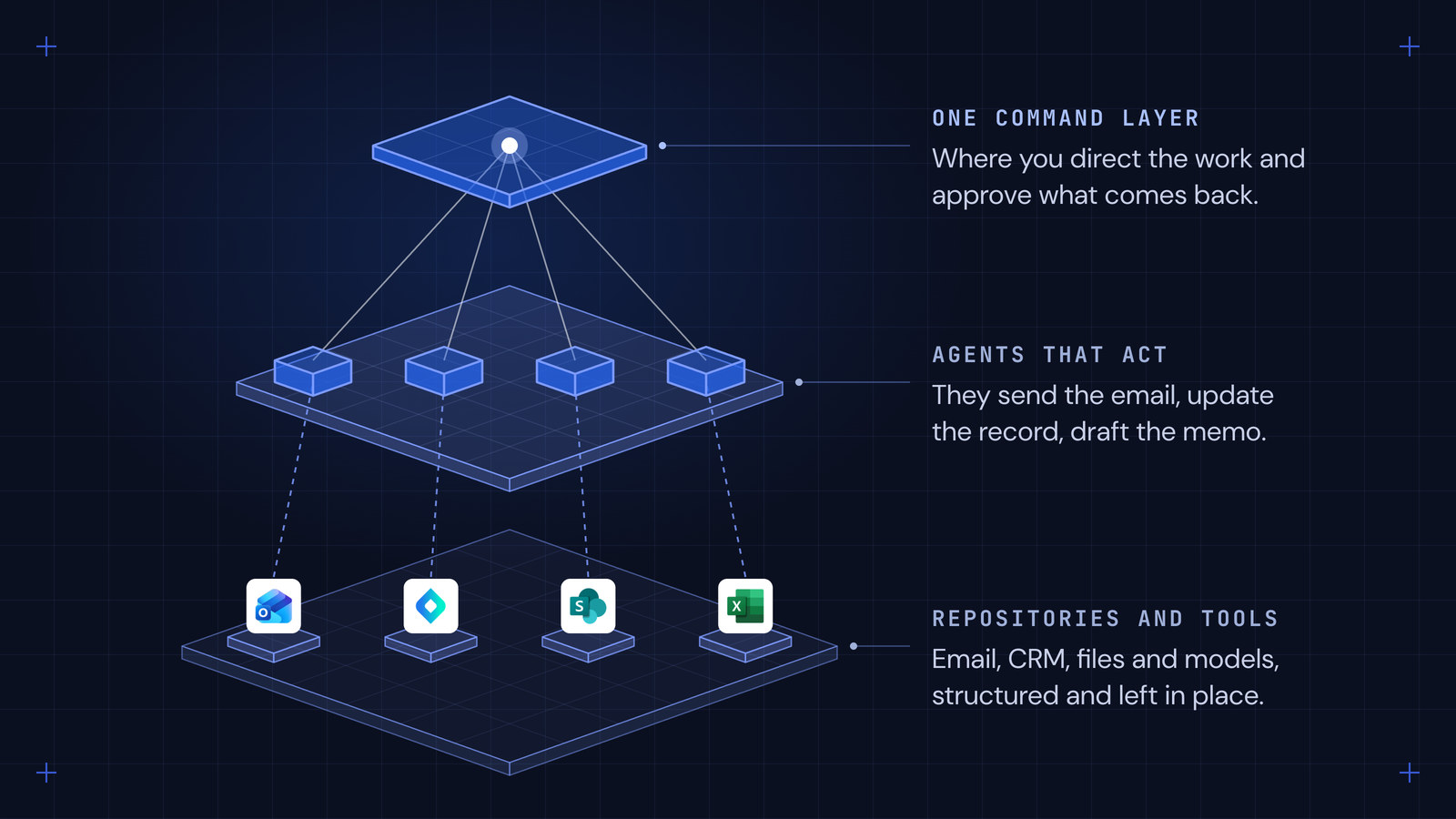
AI for investment firms means using AI on the work a private equity firm, independent sponsor or corporate development team already does: finding and screening companies, running diligence, writing the investment memo and watching what it owns. In 2026 AI does real work at every one of those stages, as an assistant a person directs and checks. What separates the firms that get value from the ones that run a pilot and shelve it is what the AI runs on. MIT’s 2025 study on enterprise AI reported that roughly 95% of generative AI pilots delivered no measurable return, and the pattern behind the number was mostly about data: a capable model on scattered, ungoverned information demos well and then cannot be trusted in daily use.
The firms getting value run AI on their own data. Their deals, relationships, past memos and portfolio reporting sit in one structured model, and every answer traces back to a source document. And the biggest return usually comes later, when the firm carries that same model into its portfolio companies and uses it to improve the decisions that move the value creation plan.
This guide covers both halves: the deal work first, then the portfolio. It is written for PE firms, independent sponsors and corp dev teams, and it links to deeper guides where one exists.
How do investment firms use AI across the deal lifecycle?
A deal is a series of information problems. Something arrives, someone decides whether it deserves time, the team digs in, forms a view, writes it up for people who will challenge it, transacts and then watches the business. Each step is mostly reading, structuring, cross-checking and drafting against information the firm already holds, which is the work AI does well.
| Stage | What AI does | What a person still does |
|---|---|---|
| Sourcing | Scores targets against the thesis, watches for triggers, finds the warm path in | Builds the relationship and makes the call |
| Screening | Reads the CIM or teaser, extracts the figures, checks them against the mandate | Decides which deals survive the first cut |
| Diligence | Reads the data room, flags inconsistencies, answers questions with page citations | Judges what the findings mean for price and risk |
| Investment memo | Drafts from the deal record with every figure traced to source | Forms the view and defends it at committee |
| Portfolio | Pulls KPIs on a schedule and flags variance before the board pack | Acts on what the variance says |
Diligence and the memo are covered in depth in AI from diligence to investment memo, and the reporting side in AI portfolio monitoring. The rest of this page deals with the choices that decide whether any of it holds up: what kind of tool to buy, what data it runs on, and how far into the portfolio it reaches.
What do AI copilots for private equity do well?
Most of what is marketed as AI for private equity is a research copilot: a chat interface over filings, data rooms, expert calls and the web. The main ones are worth naming, because they are good at their jobs.
Rogo is built for finance work. It reads filings and data rooms quickly and handles the questions an analyst asks during diligence, such as revenue by segment or what changed in the latest quarter. Hebbia fills a grid of answers across a stack of documents, one row per document and one column per question, which suits running the same diligence question across every contract in a data room. AlphaSense is strongest on research before there is a data room at all: expert call transcripts, broker research, filings and news in one search. Brightwave produces longer synthesized research reports, which fits early thesis work. Harvey is a legal tool and very good at contract review, though it is often lumped in with the others. Then there are the general assistants, ChatGPT, Claude and Microsoft Copilot, which analysts use all day for drafting and quick research.
For a fast, one-off question, a copilot is the right tool. Sizing an unfamiliar market before a first call, pulling a comp set or getting a first paragraph of a memo section down so someone is editing instead of staring at a blank page: none of that needs the firm’s own history.
Where do copilots stop?
Every tool in that list shares two limits, and neither is a defect. They come from the design of a chat interface over connectors.
The first is memory. A copilot keeps no lasting record of the firm. It does not know what the team concluded on a similar deal last quarter, which red flags it already ran down in the sector, or which version of the model everyone agreed was final. Each session rebuilds an answer from whatever the tool can see at that moment, so the same question can get a different answer next week.
The second is action. A copilot answers and then stops. It cannot update the CRM, write a finding back to the deal record, move a task forward or send the follow-up. Someone has to carry the answer into whichever system the firm runs on, and much of the time saved by a fast answer leaks back out in that hand-off.
So the useful question for a firm is what its AI is allowed to reason over, and what it can do with the result. Every vendor rents broadly the same frontier models, so the difference has to come from the firm’s own data, which no competitor can buy.
What does it mean to run AI on the firm’s own data?
It means structuring what the firm knows before pointing a model at it. Deals, companies, people, documents, meetings, models, memos and portfolio reports are defined once as connected objects, with each fact linked to the system and document it came from. That structure is a company ontology, one model of the business. For an investment firm the business is its deal flow, its relationships and its portfolio.
Agents then run on that model instead of on a search index. Two things change. Answers stay consistent, because the facts underneath are stable and each one traces to a document, version and page. And the agent can act: update the deal record, log the call, flag the variance, draft the follow-up from what the firm actually knows.
One lower-middle-market PE firm we worked with had five years of deals spread across data rooms, laptops, inboxes and folders nobody could find. “Why did we pass?” took half a day to answer. We connected its deals, documents, email, models and memos into one model, and put the AI assistant the team already used on top of it. Every answer now cites its source, and the firm reports it is 10 times faster to a decision on a new deal (case study). A boutique M&A advisor had the same problem in a different shape, with its pipeline in a spreadsheet and its relationships in people’s heads, and now runs a CRM that fills itself from email and calls (case study).
The record gets more useful with every deal the firm looks at. That is the reason to build it, and it is also why a generic research tool, however good, gives every subscriber roughly the same result.
How does AI help with deal sourcing?
Sourcing is two jobs. Discovery is finding companies the firm did not know existed. Prioritization is deciding which of the companies it could look at deserve a partner’s time this week.
Bought databases are built for discovery and are worth paying for. Grata and Sourcescrub are strong on keyword and similarity search across private companies. PitchBook remains the broadest single source of funding, ownership and deal data. Cyndx pairs discovery with comparables and valuation context, and Affinity is the usual choice for relationship tracking, especially in venture. No firm’s own network covers the whole market, so this coverage matters.
The trouble is that every firm buys the same databases and sees broadly the same companies. Putting a generic AI layer on top gives the same list, read faster, still shared with every competitor holding the same subscription. Prioritization is where a firm’s own record earns its place, and AI helps there in four ways:
- Scoring against the thesis. Inbound teasers and outbound targets are scored against the fund’s actual criteria (revenue range, margin profile, sector, geography), so a partner works from a ranked shortlist.
- Watching for triggers. Funding rounds, executive departures, new sites or regulatory filings that the firm has learned matter in its sectors are flagged when a company starts to move.
- Finding the warm path. Before anyone cold-emails a founder, an agent checks the firm’s own record. Has someone here met this person, backed a company they advise, or passed on a deal with them two years ago for a reason worth revisiting?
- Drafting the outreach. The first note is drafted from what the firm has observed about the company and the sector, including the connection if there is one.
Ranking by fit and proximity together changes the order. A slightly weaker fit that the firm has a strong connection into can sensibly outrank a better fit that would be a cold approach. Independent sponsors feel this most, since their pipeline is almost entirely their own relationships.
How does AI screen inbound deals and acquisition targets?
Inbound deal flow carries a reading tax. A CIM lands and someone has to read it, pull the numbers, reconcile them and decide whether it clears the mandate. Screening agents do the reading and the reconciliation and return a structured, scored first read, so judgment goes to the deals that survive.
New Majority Capital, which backs entrepreneurs acquiring small businesses, was spending 10 to 15 hours reviewing each deal before anyone knew whether it was worth pursuing. With DealSage that dropped to under an hour, and its team screened 105 deals in the first 60 days, on one review protocol across its network (case study). A serial brokerage acquirer had a similar problem with financials arriving in more than twenty carrier and agency formats, each re-keyed by hand (case study).
Corporate development teams screen differently. A fund weighs targets against a thesis that is fairly abstract by design. A corp dev team weighs them against something concrete: whether this company plugs a specific gap in what the business already sells, brings customers the sales team can cross-sell into, or extends a channel it has spent years building. That is strategic fit, and it can only be measured against the acquirer’s own record of its product lines, customer contracts, partners and past integrations. Target databases have no view of any of that, since none of it appears in a target’s filings or website.
Bolt-ons are the clearest case. A target with strong growth and margins can still be a poor bolt-on if it duplicates a capability the platform already has. AI on the platform’s own data can run a pipeline of small targets against its product gaps, customer segments and geographic footprint, and flag the duplication a financial screen would miss.
Why is the bigger payoff inside the portfolio companies?
Because that is where the value is created. Better sourcing and faster diligence help a firm buy well. The return on a deal depends on what happens in the company over the following four or five years, and most of that comes down to operating decisions: which customers are profitable, where pricing has drifted, how crews or plants are scheduled, whether the month-end numbers can be trusted.
Most firms see their portfolio through a monthly reporting pack. Each company runs its own systems and reports in its own shape, and someone at the firm rebuilds the picture from spreadsheets and board decks. Structuring that intake helps. One mid-market PE firm got back about 40 hours a month by having portfolio P&Ls in every format reconciled into one standard automatically (case study), and a B2B SaaS growth fund now computes its SaaS metrics from founder financials that arrive in any format (case study).
The larger step is to build the same kind of model inside the companies themselves. With one PE-backed field services company, that meant connecting the data warehouse, finance, billing, HR and every customer contract, sizing the opportunity by area of the business, then building what the numbers pointed to: a contract review app that found accounts where pricing had drifted from the agreement, a crew productivity view for operations, finance reporting that runs from the model, and an agent that writes the weekly operations review before Monday’s meeting. Another PE-backed services business reconciled its operating, billing and accounting systems and put predictive models on top. It now catches problems while there is still time to fix them, with 30% fewer quality and billing incidents and five times as many high-risk jobs caught as random audits found (case study).
The same pattern fits other sectors. A manufacturer can trace scrap and margin by line and customer. A distributor can see which accounts are profitable once freight, rebates and returns are counted. A SaaS company can reconcile billing against contracts and spot churn risk before renewal.
Two things make this worth more to a sponsor than to any single company. The firm’s monitoring improves, because each company reports from a model where KPIs are defined consistently and trace to source. And the work carries across the portfolio: integrations and definitions proven at one company make the second and third faster to stand up. The firm ends up with one way of seeing its businesses and a repeatable way of improving them, which is a good story to tell at exit.
What changes for corporate development teams?
A corp dev team already sits inside an operating company, so the portfolio question answers itself: the acquirer is the portfolio. The model that screens targets for fit is the same one that describes the business’s customers, products and operations.
That matters most after close, which is where most corp dev software stops. The case a board approves (the product gap a target closes, the customers it should bring, the cost synergies it should deliver) is a set of claims that can be tracked as data. With the deal thesis held in the same model as the operating numbers, AI can follow actual cross-sell, cost savings and integration milestones against it, and flag early when a deal drifts from the case it was approved on. Screening, diligence and integration then run on one continuous record.
What can AI still not do in dealmaking?
It cannot read a management team across a dinner table or carry the relationship that gets a firm into a proprietary deal. When the numbers support three different stories, it does not decide what a business is worth, and it does not own the call that puts capital at risk. AI is very good at the mechanical work underneath those decisions, and it is confidently wrong often enough that the sign-off has to stay with a person. What it buys back is time: hours that went on reading and re-keying go to judgment, relationships and price. We set out where that line sits, with a worked add-on search, in what AI can’t automate in dealmaking.
The same holds in the portfolio. An agent can draft the weekly operations review and flag the accounts where pricing has drifted. The operating team still decides what to do about them.
Where should a firm start?
With one decision the firm or a portfolio company makes often, on numbers nobody fully trusts. Screening inbound deals and answering “have we seen this before?” are common first choices on the deal side. In a portfolio company it is usually something like billing accuracy, contract pricing or the month-end close. Put a figure on what getting it right is worth, get one workflow into daily use, show it is accurate and auditable, then add the next one to the same model.
Firms that stall tend to start with a broad, firm-wide pilot on data nobody has structured. Firms that scale start narrow on a foundation they can trust and build outward, usually from the deal team into the portfolio once the approach has proved itself.
On build or buy: most firms should work with a partner unless the use case is unique to them. The difficult part is structuring the data and keeping the system secure and maintained, which is a full-time engineering job. Whoever does it should stay until the work runs in production, which is the model described in our guide to forward-deployed engineering. Firms that record calls should also read our guide to AI notetaker compliance before rolling a notetaker out to the deal team.
How DealSage works with investment firms
DealSage connects a firm’s data and systems, brings them into one model on our platform, and builds the agents and apps the team uses, with engineers embedded until the work runs in production. For an investment firm that model covers deals, relationships and portfolio reporting. For its portfolio companies it covers the operating business: customers, contracts, jobs, crews, plants, invoices.
We started in finance, and private equity firms remain how we meet many of the mid-market companies we work with. Our co-founder and CTO, Ben Amor, spent nearly ten years at Palantir, and the approach is the same one Palantir uses (one model of the business with engineers building on it), sized for the middle market. We are not affiliated with Palantir, and our guide to Palantir alternatives for mid-market companies sets out how the options compare.
If your team runs good copilots and keeps rebuilding the same context, or your portfolio companies report numbers nobody fully trusts, talk to us. We start with one decision and what improving it would be worth.
Frequently asked questions
- How are investment firms using AI in 2026?
- Mostly for the reading and assembly work in deals: screening inbound CIMs against the fund's criteria, extracting and checking figures in a data room, drafting first-pass diligence findings and investment memos with citations, and pulling portfolio KPIs together each month. Firms further along run AI on a structured record of their own deals and relationships, and some extend the same model into their portfolio companies to improve operating decisions there.
- What is the difference between an AI copilot and running AI on a firm's own data?
- A copilot is a chat interface over research tools and a few connectors. It answers the question in front of it, keeps no lasting record of the firm and cannot update a record or run a workflow. Running AI on the firm's own data means first structuring its deals, documents, contacts and portfolio reporting into one model, then putting agents on that model. Answers stay consistent over time, trace to source, and the agent can carry out the next step.
- What are the best AI tools for private equity deal sourcing?
- For finding companies a firm does not know about, Grata and Sourcescrub lead on private-company search, PitchBook is the broadest source of funding and ownership data, and Cyndx pairs discovery with comparables. Affinity is widely used for relationship tracking, especially in venture. None of them can tell a firm which targets it is closest to winning, because that depends on the firm's own relationships and deal history. AI built on that record adds the prioritization.
- How can corporate development teams use AI to screen acquisition targets?
- By checking each target against what the acquirer already owns: its product lines, customer base, channel partners and record of past integrations. Shared databases help build the list. AI on the acquirer's own record then shows which targets close a real product gap, overlap with existing customers or duplicate a capability, and can then track the approved synergies after close.
- How does a private equity firm use AI in its portfolio companies?
- It connects each company's systems (ERP, accounting, CRM, field operations, HR, contracts) into one model of the business, then builds the workflows its value creation plan depends on: billing and contract checks, crew or plant productivity, finance reporting, weekly operating reviews. Because the companies report from the same kind of model, the firm's portfolio monitoring improves too, with KPIs defined consistently and traceable to source.
- Should an investment firm build its own AI or work with a partner?
- Most firms are better off with a partner unless the use case is unique to them. The difficult part is structuring the firm's data and keeping the system secure, maintained and current, which is a full-time engineering job. MIT's 2025 study on enterprise AI also found projects run with specialist vendors succeeded more often than internal builds. Whoever does it should stay until the work runs in production.
- Is it safe to put confidential deal documents into AI tools?
- It can be, with private deployment, granular access controls, a full audit trail and a contractual commitment that the firm's data is never used to train shared models. The risk comes from consumer tools and hand-built setups with no governance, which can leak deal material quickly. Call recording adds its own consent and retention questions, covered in our guide to AI notetaker compliance.
See it on your own deals.
We build AI on your firm's own record, then embed it in the workflow your team already runs. Start with one process.