
How do we prove AI ROI to our board and sponsor?
Prove AI ROI with dollars the CFO can trace to an invoice, a payroll line or the close calendar, measured against a baseline set before the work began.
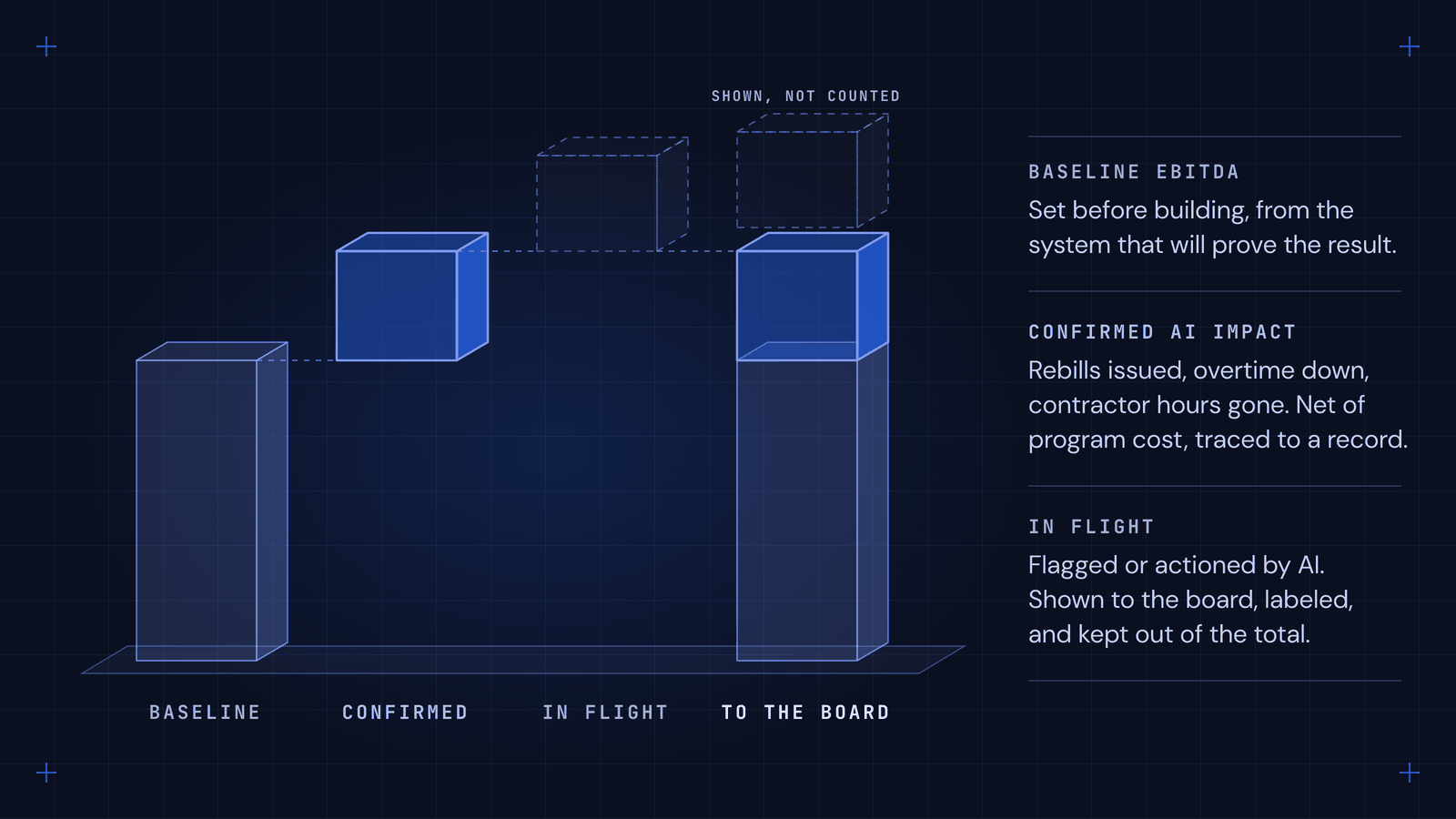
Prove AI ROI to your board and sponsor by measuring confirmed financial results against a baseline set before building. Size the opportunity by business area, deduct the full program cost and keep estimates separate from dollars the CFO can trace to company records. Hours saved, licenses bought and pilots launched do not prove a financial return.
After a year of AI activity reports, sponsors want proof before funding the next phase. Operating partners and CFOs must close what Grant Thornton, April 2026, calls the “AI proof gap”: “a disconnect between AI investment and accountability.”
What do the numbers say about AI ROI in private equity?
AI success rates depend on what each survey counts as success.
| Source | What it found |
|---|---|
 Grant Thornton, 2026 |
46% of PE leaders are scaling AI across functions; 24% report revenue growth from AI; 45% are still piloting |
| Grant Thornton, April 2026 (nearly 1,000 US leaders, all industries) |
Companies with fully integrated AI report AI-driven revenue growth at 58%, against 15% for those still piloting |
 FTI Consulting, May 2026 (200 fund and operating leaders) |
95% of funds report AI initiatives meeting or exceeding their original business case |
 Bain, March 2025 (investors with $3.2 trillion in assets, surveyed September 2024) |
Nearly 20% of portfolio companies have operationalized generative AI use cases and are seeing concrete results |
 MIT NANDA, July 2025 |
95% of organizations are seeing no business return from $30 to $40 billion of enterprise generative AI spending |
The two 95% figures answer different questions. FTI measures performance against the fund’s own original business case, and FTI notes those cases “were often conservatively scoped.” MIT NANDA asks whether organizations saw any business return at all, from a smaller sample: 52 interviews, 153 survey responses and a review of more than 300 public AI initiatives, according to The Register. Grant Thornton and Bain sit between them, with roughly one company in four or five showing results it can point to.
The lesson for a CFO is simple. The board believes the number that was defined before the work started and checked by finance. Success measured against your own target will not survive a buyer’s diligence.
What counts as AI ROI, and what doesn’t?
AI usage becomes financial value only when it changes revenue or cost. Keep these reporting stages separate:
- Usage. Logins, prompts and seats show that people opened the tool.
- Adoption. People use the workflow and act on its output. The controller stops keeping the old spreadsheet.
- Flagged value. AI finds a contract billed below its agreed price or unnecessary crew overtime. The value remains an estimate.
- Confirmed value. Finance verifies a result in company records: a rebill issued, lower overtime against the same season last year or contractor hours removed from the close.
- Reported value. Confirmed value, net of program costs, reaches the board’s EBITDA bridge.
Hours saved sit between adoption and flagged value. Count them as financial returns only when payroll, contractor or overtime costs fall, or the hours become visible billable work. Most time saved by AI licenses stays with the person who saved it, as we explain in why AI rollouts don’t raise company productivity.
How do you prove AI ROI in four steps?
The baseline-first method ties AI investment to evidence finance can check.
| Step | What to do |
|---|---|
| Baseline | Record billing leakage per quarter, overtime by crew and season, days to close or days sales outstanding. Use the system that will prove the result, not a survey. |
| Value map by business area | Size opportunities across billing, field operations, finance and sales. Rank by value and data access. Set expectations in ranges. |
| Confirmed-dollars ledger | Give each item a status: sized, flagged, actioned or confirmed. Link confirmed items to evidence. Include engineering, software, running costs and review time. |
| One board page | Show the EBITDA bridge from baseline to confirmed AI impact. Label in-flight value separately. Add ledger totals by status, workflow adoption, full cost and the next 90 days. |
Agree what qualifies as confirmed:
| Ledger line | Counts as confirmed when | Evidence the CFO checks |
|---|---|---|
| Billing corrections recovered | A rebill or price correction is issued and accepted by the customer | The invoice in the billing system and the contract clause behind it |
| Hours removed | The hours leave payroll, contractors or overtime, or move to billable work | Payroll and timesheets against the baseline period |
| Overtime avoided | Overtime falls against the same season last year, adjusted for volume | Payroll by crew or team |
| Faster close | Days come off the close and the staff or contractor time goes with them | The close calendar and finance hours |
| Cash collected faster | Days sales outstanding falls against baseline (report as one-time cash, not EBITDA) | Accounts receivable aging |
| Program cost | Always, from day one | Vendor invoices, engineering time, review time |
Where does AI do the proving, not just the work?
An AI agent can follow each flagged opportunity to the record that proves its value. Connect contracts and invoices from billing, timesheets from HR and payroll, the general ledger and close calendar from finance, and jobs and crews from operations into a company ontology, a shared model of the business.
Each week, the agent matches flags to rebills, credit notes or payroll lines, marking items stale when nobody has acted on them. It prepares status changes and drafts the board page and weekly operations review for the CFO to check and sign. Finance confirms the dollars before they reach the board.
Portfolio monitoring software is the right place for the sponsor’s scheduled KPI reporting. The link from an AI flag to a dollar in company records usually needs building.
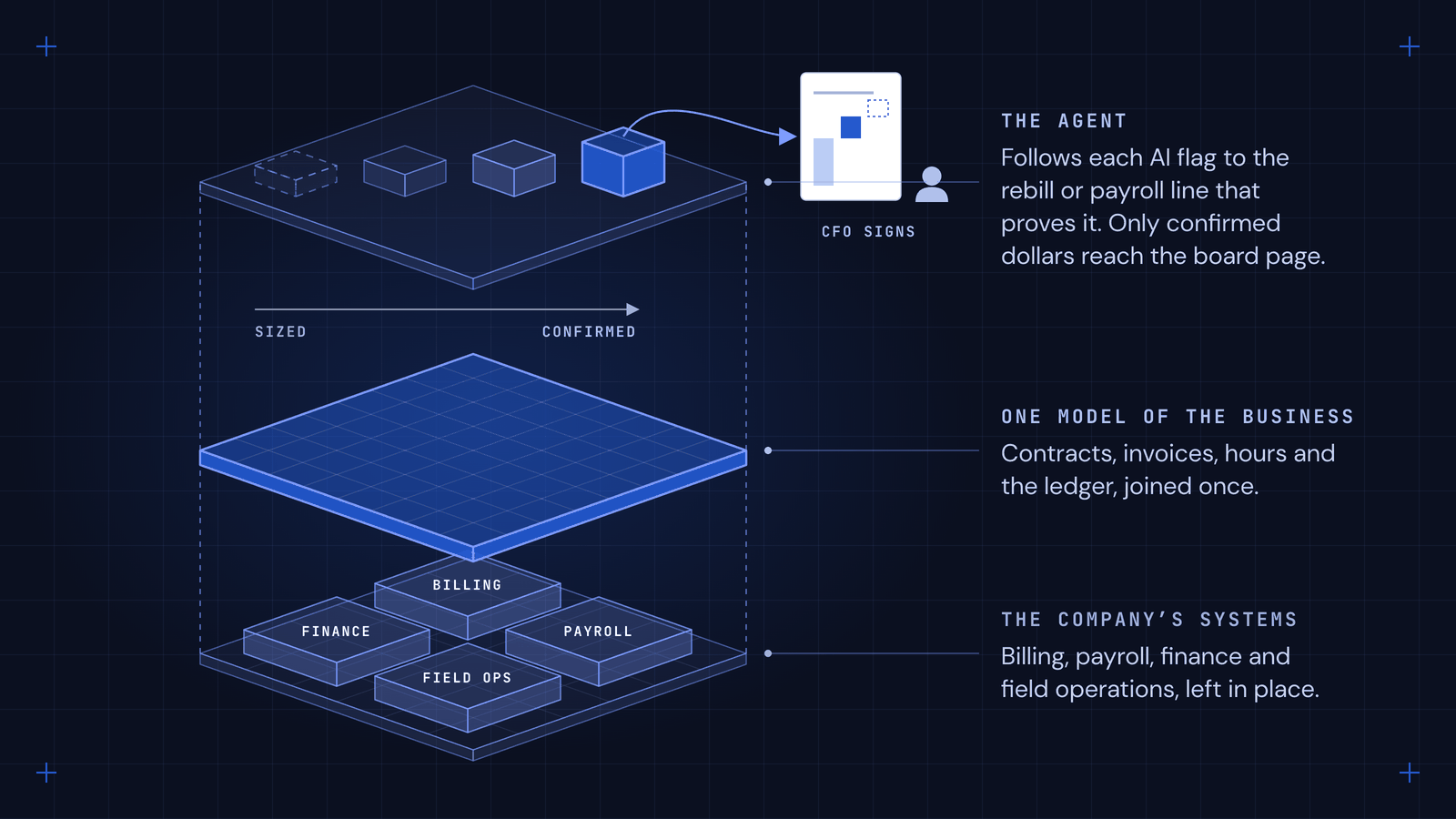
At a PE-backed field services company, we connected the data warehouse, finance, billing, HR and every customer contract, then sized opportunities by business area. A contract review app compared agreements with billing and flagged pricing differences. The agreed measure was confirmed billing corrections and revenue recovered. An agent prepared the weekly operations review from the same model, giving leadership and the sponsor the same figures. See forward-deployed engineering.
What do these numbers not tell us?
These surveys do not prove what AI will earn in your company. Their results rely on executive self-reporting, without checks against company accounts. Grant Thornton’s April 2026 release warns that correlations “should not be interpreted as evidence of causation.” Fully integrated companies may simply be better run. The MIT figure rests on a small sample and press coverage of a preliminary report. The sources do not establish how much saved time becomes lower cost. That gap is why finance needs confirmed dollars.
When is this the wrong approach?
A connected ledger and an agent are unnecessary for some AI programs. For one obvious payback, use a CFO-owned spreadsheet tied to invoices. For general productivity tools such as chat assistants or meeting notes, measure adoption and survey time saved; keep those claims out of the EBITDA bridge.
During a sale process, buyers will test AI claims anyway. An independent accounting or consulting review carries more weight than a new internal system. Without baseline data, spend the first month recording it before building AI.
| Approach | Best for |
|---|---|
| CFO spreadsheet tied to invoices and payroll reports | One or two AI workflows, early in the program |
Portfolio monitoring software ( Chronograph,  Standard Metrics,  73 Strings) |
A sponsor collecting the same KPIs from many companies on a schedule |
| An independent review by an accounting or consulting firm | An outside view before an exit, refinancing or a large new investment |
| A connected model with an agent that keeps the ledger | Several AI workflows live, and a board that wants a trail for every dollar |
For portfolio-wide measurement, see how a private equity firm rolls out AI across its portfolio.
What should you ask before the next board meeting?
Test the AI investment case before funding the next phase.
- What was the baseline for each AI workflow, and which system did it come from?
- Which business areas did we size, and why did we build these first?
- How many dollars are confirmed, how many are actioned and how many are only flagged?
- Can finance trace each confirmed dollar to an invoice, payroll line or close record?
- Have the hours we claim to have saved left payroll, contractors or overtime?
- What did the program cost in full, including the time people spend reviewing AI output?
- Are people using each workflow when the task comes around?
- Would a buyer’s diligence team reach the same number?
Where does DealSage fit?
DealSage connects billing, finance, payroll and operations into one model of the business, sizes opportunities and embeds engineers to build AI workflows and the confirmed-dollars ledger through production. We work with investment firms and mid-market companies, using common definitions across portfolios. Built by alumni of J.P. Morgan and Palantir, we start with the baseline. If your sponsor wants proof before the next phase, talk to us.
Frequently asked questions
- How do you measure the ROI of AI in a portfolio company?
- Record one business outcome and its baseline per AI workflow before building. Count results the CFO can trace to a rebill, lower overtime or fewer contractor hours at month-end, then subtract engineering, software, running costs and review time.
- Do hours saved by AI count as ROI?
- Only when the hours leave the cost base or turn into revenue you can see. Hours saved that stay with the employee are a productivity claim, not a P&L result. Report them separately from confirmed dollars so the board can tell the two apart.
- What should an AI ROI slide for the board show?
- Show an EBITDA bridge from the baseline to confirmed AI impact, with in-flight value labeled separately and each confirmed figure tied to a source record. Add ledger totals by status, workflow adoption, full program cost and the next 90 days.
- How long before AI shows ROI a board will accept?
- Billing recovery can show confirmed dollars within the first billing cycles after launch. Overtime or contractor cost changes take longer because they need a comparable period. Set the expected timing per workflow before building.
- Why do PE firms report AI success that portfolio results don't show?
- The surveys use different tests: FTI Consulting (May 2026) found 95% of funds said AI met or beat its business case, and noted those cases were often conservatively scoped. Grant Thornton (2026) found 24% of PE leaders report revenue growth from AI. Meeting a modest business case does not establish a P&L result.
- Who should own AI ROI measurement, the sponsor or the company?
- The company's CFO should confirm each dollar; the sponsor should set common definitions and the reporting template. Vista asks each portfolio company for goals and quantified generative AI benefits in annual planning (Bain, March 2025).
- Can we prove AI ROI without connecting our systems?
- For one or two workflows, a CFO-owned spreadsheet tied to invoices or payroll reports works. As workflows multiply, manual tracking goes stale. Connecting billing, finance and payroll lets the evidence update itself.
Part of the guide: read the full guide
See it on your own business.
We connect the systems you already run into one model of the business, then embed engineers to build the AI your team uses. Start with one decision.