AI due diligence to investment memo: from data room to decision
Diligence and the IC memo are one workflow with one job: a decision the committee can defend. This guide covers what AI does at each stage, why the memo should be drafted from your own deal record, and why that record should follow the company after close.
AI due diligence is the use of AI to do the mechanical work between receiving a data room and making an investment decision. It reads every document, extracts the figures that matter, cross-checks them, answers questions with a citation to the source page, and drafts a first-call memo and then an investment committee memo for the deal team to challenge. Run on one structured deal record, it turns days of reading and assembly into hours, and it gives the committee a memo where any figure can be traced back to the page it came from.
That last part decides whether the work is useful. Diligence and the IC memo are usually treated as two jobs done by different people in different files. They are one workflow with one purpose: a decision the committee can defend. This guide walks that workflow from data room to committee and then past it, because the same record should follow the company after close.
It is written for private equity firms, independent sponsors, search funds and banks, and for mid-market companies running acquisitions of their own. A distributor buying a regional competitor or a SaaS company buying a product team runs the same diligence as a fund, usually with a much smaller team. The wider picture of how investment firms use AI is in our guide to AI for investment firms.
What is automated due diligence?
Due diligence is a structured reading problem. A mid-market data room routinely runs to thousands of files: financials, customer data, contracts, legal, HR, operations. Someone has to read all of it, work out what matters, cross-reference it and form a view before the first-round bid. Done by hand, that first pass is slow and repetitive, which is exactly when a tired analyst at midnight misses the inconsistency that mattered.
Automated due diligence puts an AI layer over the reading. A model ingests the room, extracts the figures into a structured record, and lets the team ask questions of the whole corpus at once. What comes out is a faster, more consistent first pass with every finding traceable to its source document. The verdict stays with the team.
The time saved is real. New Majority Capital’s entrepreneurs were spending 10 to 15 hours reviewing each deal before they knew whether it was worth pursuing; on DealSage that dropped to under one hour, and they screened 105 deals in their first 60 days. A serial brokerage acquirer that used to re-key every target’s financials from twenty-plus carrier and agency formats now gets one structured view in minutes.
What can AI do in a data room today?
Four things, reliably, when it works on a structured record rather than a raw pile of PDFs.
Read and extract. The model reads the entire room and pulls out revenue, EBITDA, customer concentration, working capital, debt and the operating KPIs that matter for the sector. For a field services business that might be jobs per crew and revenue per technician. For a manufacturer it is yield, scrap and capacity use. For a SaaS company it is net revenue retention and cohort churn. Each value is tied to the document, version and page it came from. The week a junior used to spend building a data pack becomes a review of an extract the machine assembled.
Cross-check and flag. Extraction is useful. Catching disagreements is where the findings are. The CIM says churn is eight percent, the raw customer file implies twelve, and a management answer in the Q&A log splits the difference. A distributor’s top-customer list in the deck does not match the sales ledger. A contract renewal term undercuts the revenue forecast. A model comparing every document against every other one surfaces these in minutes.
Answer questions with citations. The team asks the room plain questions (who are the top ten customers by revenue, and when do their contracts renew?) and gets answers with a link to the source page. The citation is the point. We make the governance case in showing your workings on AI lineage.
Draft the first-call memo. From the structured extract, an agent drafts the screening memo that decides whether the deal gets a first call: what the business does, how it makes money, what the numbers say, and the questions the team should ask management. It is a draft for a person to challenge.
Why should diligence run against your own precedent?
A generic model reads each data room cold. It knows nothing about the logistics deal you passed on last year, the customer-concentration problem that hurt a previous fund, or the question your firm always asks about deferred revenue because it learned the hard way once. Every deal is the first deal.
Diligence run on the firm’s own record works differently. The DDQs the firm has run before, the red flags it has seen in a sector, the reasons it backed or passed on similar businesses: all of it becomes context applied to the new room. The second time you diligence a commercial cleaning business, the record already knows to check contract assignability and crew turnover.
The second time you diligence a business like this one, your firm should already know what to look for.
That precedent is the part no outside tool can supply, because it sits in your firm’s history. A lower-middle-market PE firm we worked with had five years of deals scattered across data rooms, laptops and inboxes, and “why did we pass on that?” cost half a day of searching. Once those deals were connected into one record, the team reached a decision on a new deal ten times faster, with every answer cited to source (the case study is here). The structure underneath, one model of the business that agents and apps run on, is explained in our guide to the company ontology.
How does diligence get coordinated across the deal team and advisers?
Reading is half of diligence. The other half is running a process across many people at once: the deal team, counsel, the quality-of-earnings provider, commercial advisers, sometimes the target’s own management. A tool that summarizes a data room does nothing for that half, and that half is what eats the calendar.
Two things get lost. One is process: who is checking what, which requests are outstanding, what is still open a week before the bid. The other is conflict resolution. When the QoE adjusts EBITDA differently from the CIM, someone has to notice, chase it and settle on a number the memo can stand behind.
Running diligence on one shared record keeps requests, findings and open items in one place. Every stakeholder pulls from the same figures, so a number that contradicts another number surfaces against the record and does not sit unnoticed between two advisers’ emails. The record also keeps how each conflict was resolved, which matters when the committee asks.
How does AI draft an investment committee memo?
By assembling it from the deal record the diligence built. By the time a deal reaches committee, the team has read the room, built the model, run the workstreams and formed a view. All of that has to become one document that makes the case, states the risks and recommends an answer. Assembly is slow work: chasing the latest number, reconciling the model against the diligence, formatting sections, checking that the figure on page one matches the figure on page twelve.
An agent can do that assembly. It drafts the standard sections (business overview, investment thesis, financials, diligence findings, risks, structure and returns) in the firm’s own template and fills each from the record. Because the executive summary and the financials pull the same value from the same source, they cannot drift apart. There is one record under the model, the diligence and the memo, so there is nothing to re-key.
A good draft also shows what it does not know. Where the record is thin or a workstream is still open, the draft says so, so the team sees what needs a human answer before the meeting. A smoothed-over guess is worse than a gap, because it looks finished.
What makes an AI memo safe to put in front of a committee?
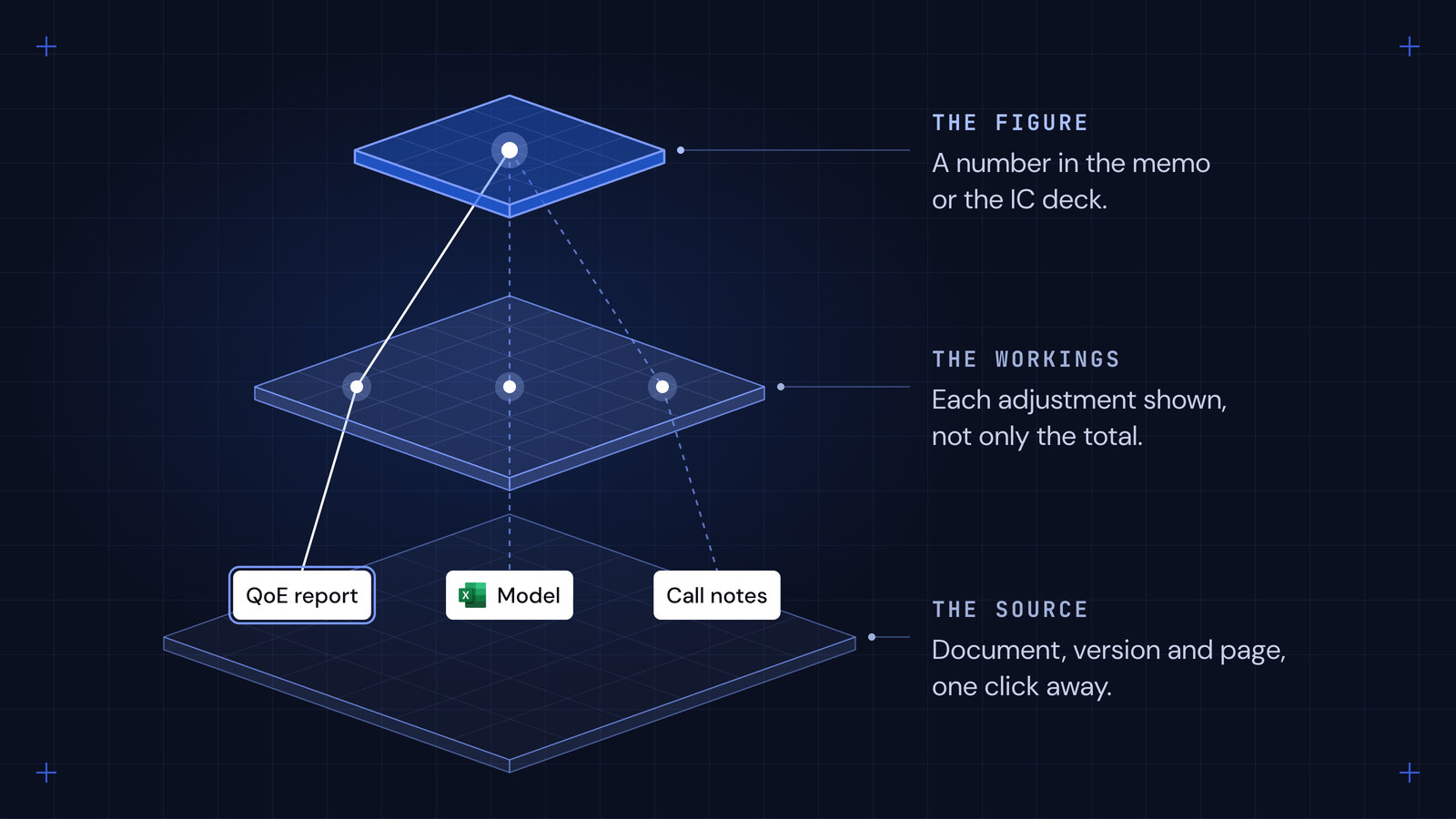
Sourcing. A committee’s job is to find the hole in the case, and it can only test claims it can trace. The test for an AI memo is whether a partner can point at any number and see, in a click, where it came from.
An AI memo you cannot audit is a liability in the room.
A general assistant will write that adjusted EBITDA is $15.8 million in confident prose, with no way to tell whether it rounded, mixed two versions of the model, or made the figure up. A memo drafted from a structured record carries its lineage. That $15.8 million links to page 24 of the QoE report, to the current version of the model, and to the reconciliation the diligence ran against the CIM. The committee does not have to trust the memo. It can check it.
The same rules apply to the inputs. Call notes from management meetings and expert calls feed the memo too, and they need to be captured in a way your compliance team accepts. Our guide to AI notetaker compliance covers that.
From data room to decision, step by step
- Connect. The data room, the firm’s prior deals, call notes and the working model sync into one structured record. Every document is versioned and every figure is tied to its source.
- Extract. The model pulls the financial, commercial and operating figures into a form the team can query and drop into the model.
- Cross-check. Documents are compared against each other and against the firm’s precedent. Conflicts and known red flags are flagged for a person.
- Coordinate. Requests, findings and open items for every workstream live on the same record, and each resolved conflict is kept.
- Draft the first-call memo. An agent writes the screening memo from the record, with the questions for management.
- Draft the IC memo. The agent assembles the committee memo in the firm’s template, every figure linked to source and every open item marked.
- Decide. The deal team challenges the draft, writes the argument and the recommendation, and takes it to committee as its own work.
What does AI still not do in diligence or at committee?
It does not make the decision. It does not decide whether customer concentration is a dealbreaker or a risk worth taking at the right price. It does not read what the CEO was really saying on the management call, or weigh a red flag against the strategic logic of a bolt-on. It does not decide what the business is worth when the numbers support three different stories.
An IC memo is written to be argued with in a room of people whose job is to find the weak point. That argument is human. AI moves the hours: the two days a junior spent assembling and reconciling go to the thesis and the risks, and the team walks in with a memo whose every figure is already traceable. We set out the limits in more detail in what AI can’t automate in dealmaking.
What happens to the diligence record after close?
In most firms, diligence ends in a folder. The QoE goes into a drive, the model stays on someone’s laptop, and three months later the operating partner asks the portfolio company for the same customer and margin data again, in a different format. The work that decided the deal stops being used the day it closes.
It does not have to. If diligence was built on a structured record of the target (its customers, contracts, pricing, margins by line of business, the KPIs the committee cared about), that record is already a first model of the company’s business. After close it becomes the starting point for the value creation plan. The definitions the deal team checked are the ones the portfolio company reports against, so portfolio monitoring starts from figures that are consistent and traceable from the first board pack.
This is where the deal work meets the company. With one PE-backed field services company, we connected the data warehouse, finance, billing, HR and every customer contract into one model, sized the opportunity by area of the business, and built what the numbers pointed to: a contract review app that found accounts where pricing had drifted from the agreement, a crew productivity view for operations, finance reporting that runs from the model, and an agent that writes the weekly operations review before Monday’s meeting. Most of the questions those apps answer are ones diligence asks first. A sponsor that builds the record during diligence starts the hold period with that model already in place.
The PE-backed services business in this case study shows the same move further along: operating, billing and accounting systems reconciled into one foundation, with predictive models flagging margin and quality problems in time to act. The engineers who embed with the company to build that work are described in our guide to forward-deployed engineering.
What AI tools help with due diligence and IC memos?
There are three groups, and they solve different problems.
| Type | Examples | What it does well | Where it stops |
|---|---|---|---|
| Virtual data rooms | Datasite, Ansarada, Intralinks | Hosts and controls documents, permissions and Q&A | Does not run the analysis or draft the memo |
| General assistants and deal AI tools | ChatGPT, Claude, deal-focused AI apps | Reads and summarizes a room fast; drafts prose | Treats each deal as an island; limited lineage to your own record |
| A structured deal record | DealSage | Diligence and the memo on your own precedent, lineage on every figure, the record carried past close | Takes setup work to connect your history and systems |
Many firms use a data room for control and a record-based layer for the analysis, the memo and what follows. If you are weighing a general chat tool against something built for the job, our comparison with ChatGPT and Claude draws the line concretely.
How DealSage does it
We connect your data room, your past deals, your call notes and your models into one record on our platform, then build the diligence and memo workflows your team runs, in your template and to your committee’s standards. Our engineers embed with the deal team until the workflow runs on live deals. When a deal closes, the same record can become the portfolio company’s model of its business, and the same team can build on it there.
We are a young company, founded in 2025, and we work with a small number of clients at a time because our engineers embed. If you want a summarizer over one data room, a general AI tool is cheaper. If you want diligence that applies what your firm already knows, a memo the committee can check line by line, and a record that keeps working after close, talk to us. We start with one live process.
Frequently asked questions
- How can AI automate due diligence?
- AI reads every document in the data room, extracts the key financial and commercial figures into a structured record, cross-checks them for inconsistencies, and answers diligence questions with a citation to the source page. It then drafts a first-call memo the deal team reviews. The strongest setups also check the new deal against the firm's own prior DDQs and past reviews, so the team starts with what it already knows. A person directs the review and signs off every finding.
- Can AI write an investment committee memo you can actually use?
- Yes, as a first draft the deal team then owns, provided it is assembled from the firm's own deal record. The agent drafts the standard sections (business overview, thesis, financials, diligence findings, risks, structure and returns) and fills them with figures already extracted and checked during diligence, each linked to its source. It also marks where the record is thin. The team writes the argument and the recommendation.
- What's the best automated due diligence software?
- It depends on the job. Virtual data rooms such as Datasite, Ansarada and Intralinks host and control the documents. General assistants and deal-focused AI tools read and summarize them. A structured deal record, which is what DealSage builds, runs diligence and the memo against your own precedent with lineage on every figure. Many firms use a data room for control and a record-based layer for the analysis and the memo.
- Why does source lineage matter in an AI-drafted memo?
- An investment committee exists to challenge the case, and a claim nobody can trace can only be believed or ignored. Lineage links every figure and quote to the document, version and page it came from, so a partner can check any line in a click. It also shows when two sources disagreed and how the diligence resolved it.
- Is it safe to run diligence documents and IC memos through AI?
- It can be, with the right deployment: a private environment, customer-controlled keys, access controls by deal and role, a full audit trail, and a contractual guarantee that your data is not used to train shared models. The risk is pasting confidential deal material into consumer tools with no governance.
- Does AI replace the deal team's judgment in diligence or at committee?
- No. AI does not decide whether customer concentration is a dealbreaker, what management meant on the diligence call, or what the business is worth. It removes the reading, reconciling and formatting so the team spends its hours on those calls, and it is wrong often enough that a person has to check its work.
- What happens to the diligence work after the deal closes?
- In most firms it goes into a folder. If the diligence was built on a structured record of the target's customers, contracts, margins and KPIs, that record can become the portfolio company's first model of its own business. The value creation plan, the 100-day plan and portfolio monitoring then start from definitions the deal team already checked.
See it on your own deals.
We build AI on your firm's own record, then embed it in the workflow your team already runs. Start with one process.