Palantir alternatives for mid-market companies
Palantir's model works. Its pricing is designed for governments and the Fortune 100. Here is what a company with $20 million to $500 million in revenue can buy instead, what each option includes, and how to choose.
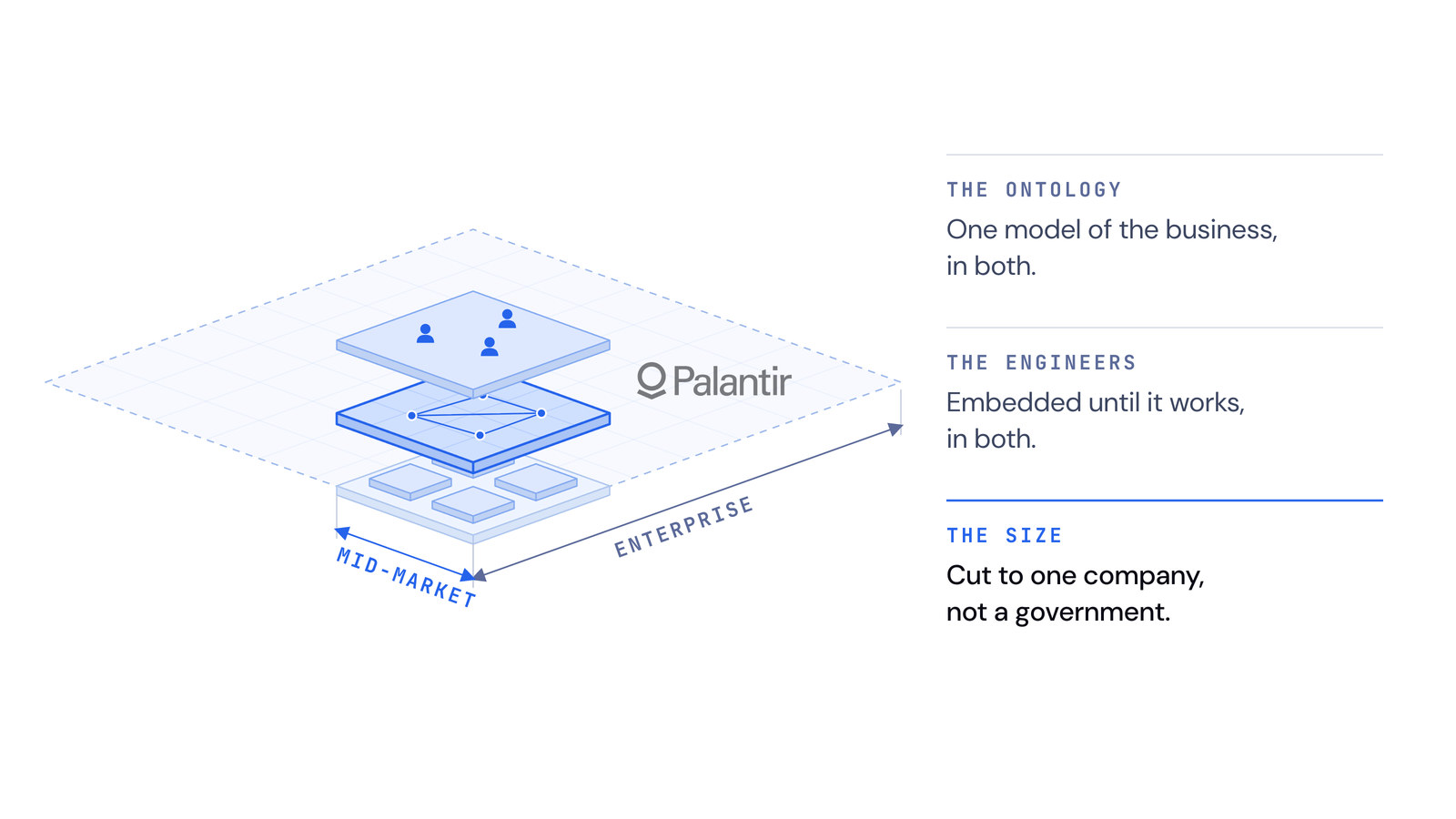
Palantir’s model works. It builds one model of a business, which it calls the ontology. Its engineers then work inside the customer’s business to build applications and AI on that model, staying until people use the software. For most mid-market companies, the obstacle is pricing designed for governments and the Fortune 100.
This guide covers what Palantir sells, what it costs, and the three types of alternative available to a company with $20 million to $500 million in revenue. It also explains how to choose between them. The figures are from public sources as of October 2026. We are one of the alternatives, so read the DealSage section with that in mind.
What does Palantir actually sell?
Two things, sold together.
The first is software. Foundry connects a company’s systems and builds the ontology: a definition of what a customer, an order, a job or an asset is, how each relates to the others, and which system is authoritative for each fact. AIP puts AI models to work on that foundation, so an agent can read and act on defined business objects instead of inferring them from documents.
The second is people. Palantir’s forward-deployed engineers sit with the customer’s teams, learn how the business runs and build the workflows on Foundry. The role started at Palantir in the early 2010s, and until about 2016 the company employed more of them than ordinary software engineers.
Most of the value is in the combination. Many vendors sell either the software or the engineering services. Very few sell both, which explains the demand for a Palantir alternative built for the mid-market.
How much does Palantir cost?
Palantir does not publish a US price list. Its UK government listing (G-Cloud 14, 2024) includes pricing and is the best public source:
| Item | List price |
|---|---|
| Discovery package (up to 3 months) | £50,000 to £250,000 |
| Pilot licence | £50,000 to £500,000 |
| Foundry licence, single organization | £3,000,000 a year |
| Implementation and engineering services | £150,000 per person per quarter |
| Use-case maintenance | £6,000 to £20,000 a month |
At list price, one engineer for a year costs about £600,000. Firms that implement Palantir report that a deployment for a single, narrowly defined use case costs around $250,000 a year. Most first contracts range from $500,000 to $2 million a year, with implementation in the first year often costing as much again.
The customer base explains the pricing. Palantir’s 2025 annual report says its top 20 customers paid an average of $93.9 million each, and in Q2 2026 it closed 73 deals worth $10 million or more. A company that size has a data team, an IT organization and a budget line for transformation. A $150 million distributor has a controller, an ERP and a lot of spreadsheets.
Why do mid-market companies look for an alternative?
Cost is the obvious reason. The less obvious one is fit.
Palantir’s model assumes the customer can contribute substantial resources: internal engineers to work alongside its own, data owners with time to answer questions, and a transformation office to manage adoption. Mid-market companies rarely have those resources. Their systems are fragmented (an accounting package, a CRM, a field operations tool, payroll, perhaps a warehouse), and much of their operating knowledge sits with a few people. The essential work is connecting those systems and documenting unwritten business rules. It needs someone who will still be there in month six.
So the useful question is less “what is cheaper than Palantir?” and more “who will do the part Palantir’s engineers do, at a price that suits a company our size?”
What are the alternatives?
They fall into three groups.
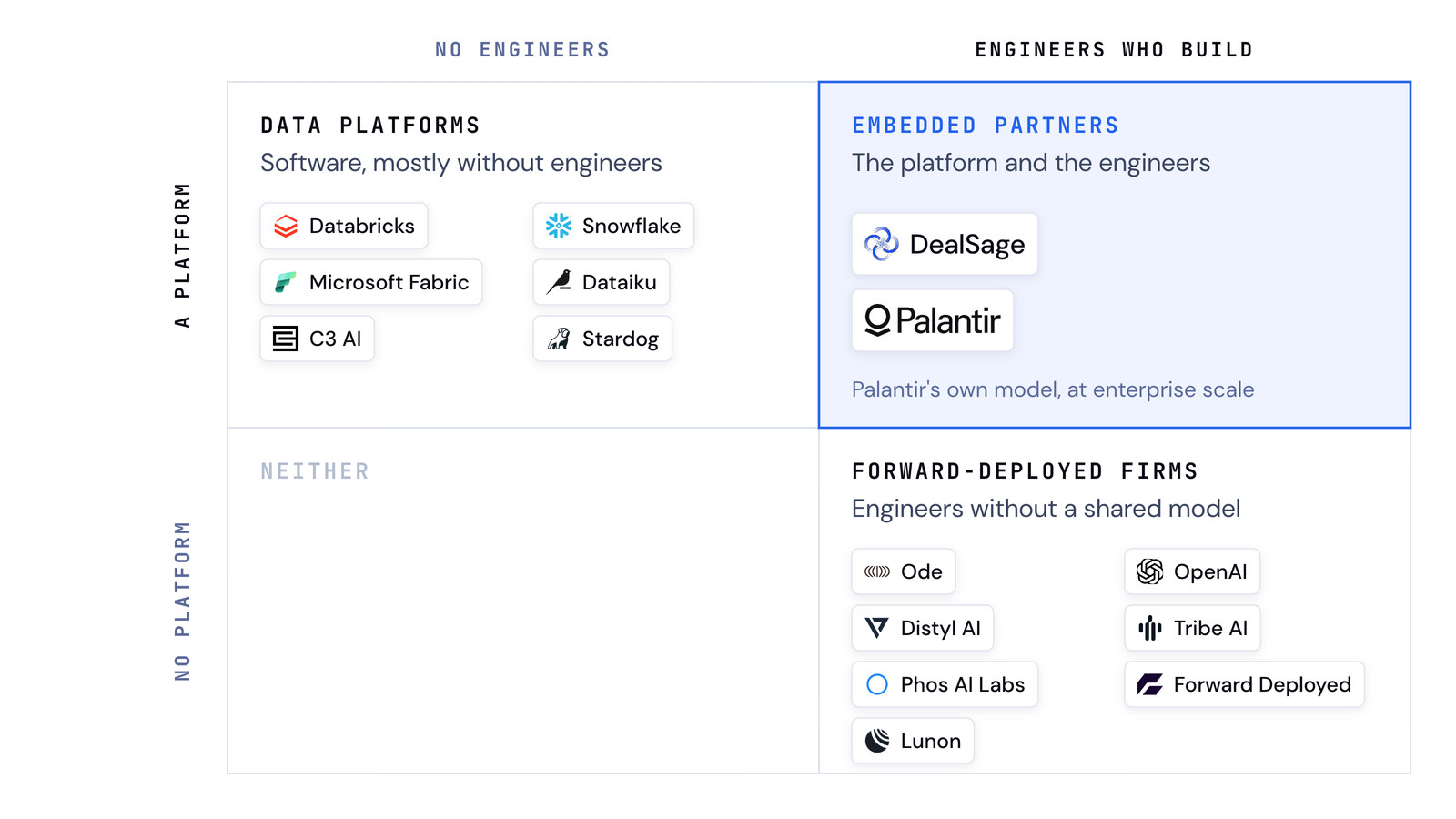
1. Data platforms: the software, mostly without the engineers
These platforms store and process your data, increasingly with AI built in. Starting costs are low and scale with use. None includes an operational ontology of your business. Their engineering help comes as paid professional services or through partners; Databricks now runs its own forward-deployed engineering team, aimed mainly at strategic accounts.
| Platform | Public price signal | Best for |
|---|---|---|
 Databricks |
Pay as you go, no upfront commitment | Companies with a data engineering team that wants an open lakehouse |
 Snowflake |
From $2 per credit on demand | Teams that mainly need a data warehouse, staffed by partners |
 Microsoft Fabric |
About $263 a month (F2) to $8,410 a month (F64) | Microsoft 365 shops that want to stay inside one vendor |
 Dataiku |
£15,000 to £200,000 a year (UK G-Cloud); median buyer about $160,000 | Analytics and data science teams |
 C3 AI |
$500,000 for a six-month initial deployment | Large enterprises that want prebuilt industry AI apps |
 Stardog |
Free tier; enterprise by quote | Adding a semantic layer over an existing warehouse |
The key is the “best for” column. Each platform assumes someone in the company, or a partner you hire separately, will model the business and build the applications. For a mid-market company without a data team, buying a platform alone usually produces a well-organized warehouse with little change in how people make decisions.
2. Forward-deployed services firms: the engineers, mostly without the platform
This group has grown fast in 2026. One study reported by TechCrunch in July found 70% of companies planning to hire forward-deployed engineers by the end of Q2.
| Firm | Who it is built for | Notes |
|---|---|---|
 Ode (with Anthropic) |
Mid-sized companies across sectors | Formed by Anthropic, Blackstone, Hellman & Friedman and Goldman Sachs; about 100 engineers; absorbed Fractional AI; Claude-first |
 OpenAI Deployment Company |
Large business customers | Over $4 billion raised; bringing in about 150 forward-deployed engineers through its Tomoro acquisition; OpenAI models |
 Distyl AI |
Fortune 500 | Platform plus embedded engineers; multi-year contracts reported in the tens of millions |
 Tribe AI |
Enterprise | Network of 600+ engineers staffed in small senior teams; model-agnostic |
 Phos AI Labs |
Companies with $5 million+ revenue | Publishes prices: discovery from $10,000, then $10,000 to $50,000 a month |
 Forward Deployed |
PE portfolio companies | Founder-led; one workflow in 30, 60 and 90-day phases |
 Lunon |
Private capital and complex enterprises | Founded 2025; pairs diligence work with embedded build |
These firms provide the engineering capacity. What varies is what they leave behind. Some build each workflow as a separate project using whichever tools suit it, so the fifth build costs about what the first did. Ask whether they build a shared model of your business that each new workflow extends, and who owns and runs it when they leave. Two of the firms with the most funding are also tied to one model provider, which matters if you want to switch models as they improve.
3. Embedded partners: the platform and the engineers at a mid-market price
The third group adapts Palantir’s full model, combining an ontology and engineers, for mid-market companies. DealSage is in this group. Palantir’s own program for “small & mid-sized businesses” fits this category more narrowly. It has a page on Palantir’s site but publishes no price, timeline or minimum.
The appeal is the same as Palantir’s. Every workflow builds on one model of the business, making each faster and cheaper to build than the last. Engineers are measured on whether the business makes better decisions, rather than how much software they deliver. The risk is also the same: you depend on the partner’s platform, so ask what you own and what happens to your data and your model if you leave.
How should a mid-market company choose?
Ask every vendor the same four questions.
Is there a real model of the business underneath? Ask them to show you how a customer, a contract or a job is defined, and where each fact comes from. If the answer is “the AI reads your documents”, there is no model, and the answers will be hard to trust.
Who does the building? If the answer is “your team” or “a partner of ours”, include that cost. For most mid-market companies, it is the largest expense in the first year.
Do the engineers stay through production? A roadmap and a pilot are not the same as a workflow people use every week. Ask for a reference customer where something has run in production for six months.
What does year one cost in total? Include the license, implementation, internal staff time and partner fees. Palantir’s own price list is useful as a ceiling.
Start with a business decision. Pick one the business makes often using numbers nobody fully trusts. Estimate what getting it right is worth, then judge every option on how quickly it can deliver that value.
When is Palantir the right answer?
Palantir is the right choice for some organizations. A very large organization with complex operations, a large internal team and a budget in the tens of millions gets more from Palantir than from anyone else on this page. The same applies to defense and government work, and to companies that need its security accreditations. A company with a strong data team that specifically wants Palantir’s software can also make the economics work.
For most companies between $20 million and $500 million in revenue, that means paying for substantial capacity they will not use.
How DealSage does it
DealSage brings the same model to mid-market companies. We connect the systems you already run, bring their data into one model of your business on our platform, and build AI workflows, agents and apps for your team. Our engineers stay embedded until that work runs in production. We were built by alumni of J.P. Morgan and Palantir. We are not affiliated with Palantir.
With one PE-backed field services company, that meant connecting the data warehouse, finance, billing, HR and every customer contract. We assessed the opportunity in each area of the business, then built what the numbers supported: a contract review app that found accounts where pricing had drifted from the agreement, a crew productivity view for operations, finance reporting that runs from the model, and an agent that writes the weekly operations review before Monday’s meeting.
There are honest reasons to pick someone else. We were founded in 2025, so we are younger than most firms on this page, and we work with fewer clients at a time because our engineers embed. If you want a platform for your own data team to build on, the platforms above are cheaper.
If you are considering your options, identify one decision your business makes using numbers nobody fully trusts and estimate what improving it is worth. Get in touch to discuss it.
Frequently asked questions
- How much does Palantir cost?
- Palantir does not publish a US price list, but its UK G-Cloud 14 listing (2024) includes pricing. It lists discovery packages of £50,000 to £250,000, pilot licenses of £50,000 to £500,000, an organization-wide Foundry license at £3 million a year, and implementation and engineering services at £150,000 per person per quarter, which is about £600,000 per engineer-year. Palantir's 2025 annual report says its top 20 customers generated an average of $93.9 million in revenue each. Implementation partners report that most first contracts at mid-market and large companies range from $500,000 to $2 million a year.
- Does Palantir work with mid-market companies?
- It has a page for "small & mid-sized businesses" under its Palantir for Builders program, and it runs short bootcamps on customer data. It publishes no price, timeline or minimum for that offer. In practice, Palantir's commercial growth comes from very large contracts: in Q2 2026 it closed 73 deals worth $10 million or more. A mid-market company can buy Palantir, but it pays for a model designed for institutions with large internal teams.
- What is the best Palantir alternative for a mid-market company?
- It depends on the company's internal capabilities. A company with a capable data and engineering team can buy a platform such as Databricks, Snowflake or Microsoft Fabric and build on it. Most mid-market companies lack that team and need engineers as well as software. They should look at forward-deployed firms or an embedded partner that provides both. Ask who connects the systems, who builds the model of the business, and who stays through the first workflow's launch into production.
- Is Databricks or Snowflake a Palantir alternative?
- Partly. Both are data platforms with AI features and low starting costs: Databricks is pay as you go and Snowflake starts at $2 per credit on demand. Neither includes an operational ontology of your business. Databricks now has its own forward-deployed engineers, billed as professional services and aimed mainly at its largest strategic customers. A mid-market company that buys either platform usually still needs a partner or an internal team to model the business and build the applications people use. That work is part of what Palantir is paid to do.
- What is a forward-deployed engineer?
- An engineer who works alongside the customer's team and stays until the software they build is running in production and being used. Palantir created the role in the early 2010s and called it Delta internally. OpenAI, Anthropic and a growing number of services firms have since adopted it because AI projects most often fail between demonstration and daily use.
- How is DealSage different from Palantir?
- DealSage uses the same model (one ontology of the business, with forward-deployed engineers who build on it until it runs in production), sized and priced for companies with tens or hundreds of millions in revenue rather than billions. It was built by alumni of J.P. Morgan and Palantir. DealSage is not affiliated with Palantir. Palantir is the better choice for a very large organization that needs its scale, its security accreditations or its defense and government work.
See it on your own deals.
We build AI on your firm's own record, then embed it in the workflow your team already runs. Start with one process.