
Why do most AI pilots never reach production?
An AI demo is not a working business process. Before funding the next pilot, settle who owns the result, where people use it, which numbers it trusts and who runs it after launch.
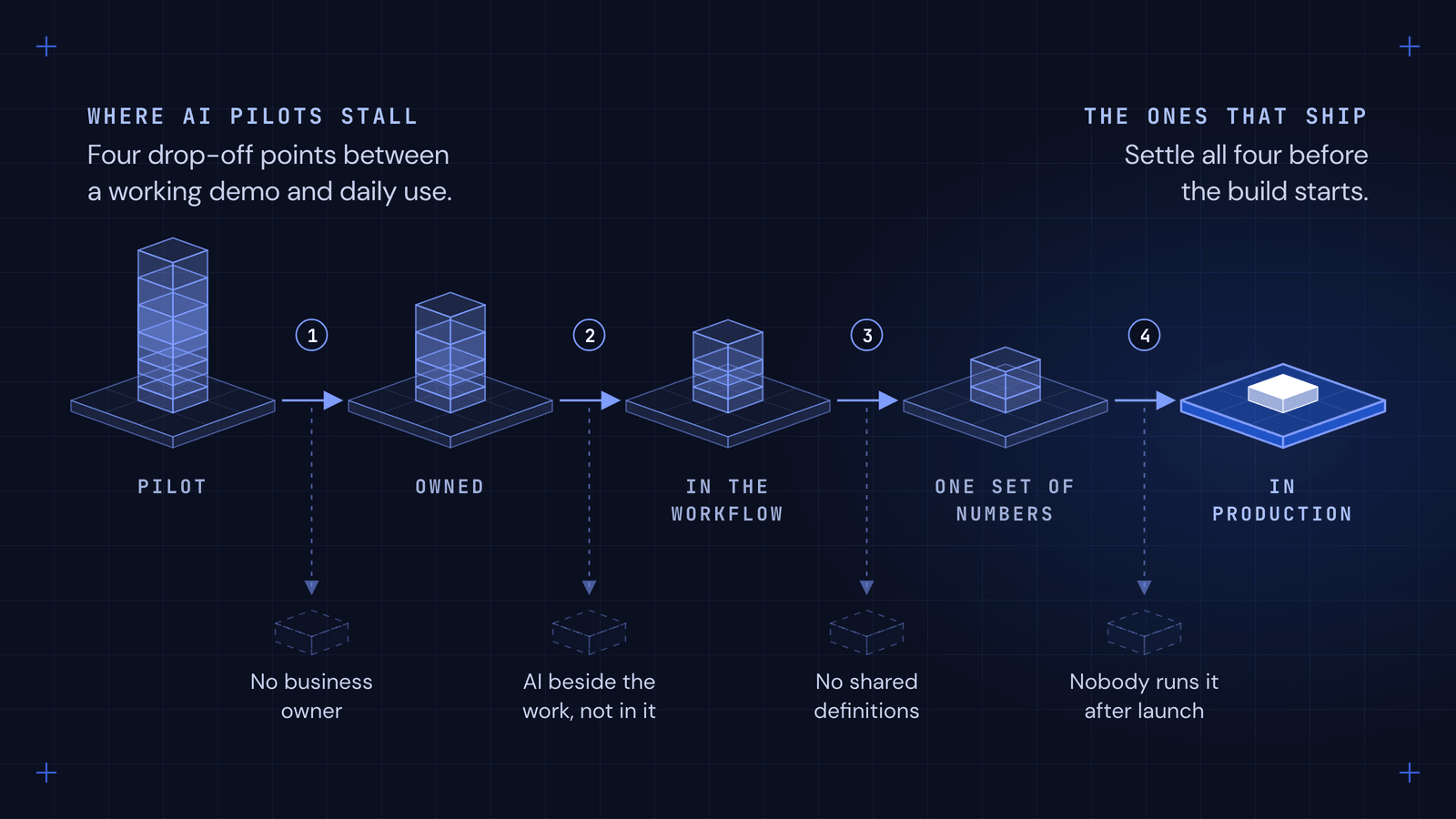
Most AI pilots never reach production because four things are left unsettled: nobody in the business owns the result, the AI sits beside the work instead of inside it, teams define the numbers differently, and nobody is set up to run it after launch. IDC reported in March 2025 that only 4 of every 33 AI proofs of concept reached production. The AI model is rarely the problem.
A COO, CFO or head of operations is right to ask what the money bought. Six months after an impressive demo, the weekly operations review, month-end close and board pack may run exactly as before. The sponsor or board needs a decision: kill the pilot, fix it or start another.
How many AI pilots actually reach production?
The failure rates differ because the studies count different outcomes.
| Source | Date | What it found |
|---|---|---|
 MIT NANDA, The GenAI Divide |
July 2025 | 60% of organizations evaluated custom enterprise AI tools, 20% reached pilot stage and 5% reached production; 95% of organizations were getting zero return |
 Gartner |
July 2024 | At least 30% of generative AI projects will be abandoned after proof of concept by the end of 2025 |
| Gartner |
June 2025 | Over 40% of agentic AI projects will be canceled by the end of 2027 |
 IDC, with Lenovo |
March 2025 | For every 33 AI proofs of concept, 4 reached production; 88% did not make it to wide deployment |
 S&P Global Market Intelligence |
March 2025 | The average company scrapped 46% of AI proofs of concept before production; 42% abandoned most of their AI initiatives, up from 17% a year earlier |
 McKinsey, The state of AI |
August 2026 | Nearly 9 in 10 organizations use AI regularly in at least one function; 44% say they are scaling it; 37% report a meaningful impact on EBIT |
Sources: MIT NANDA report (PDF); Gartner, July 29, 2024; Gartner, June 25, 2025; IDC via CIO.com, March 25, 2025; S&P Global via CIO Dive, March 14, 2025; McKinsey, as reported by Fortune, September 2, 2026.
Gartner’s July 2024 forecast set a floor: “at least” 30% abandoned after proof of concept. It excludes pilots that continue unused. S&P’s 46% counts scrapped projects; IDC’s 88% counts those short of wide deployment. A pilot used by one team need not be scrapped to fall short of that test.
MIT’s 95% measures the harder test of profit impact; its 5% production figure covers custom enterprise tools. The July 2025 report reviewed over 300 public initiatives, interviewed 52 organizations and surveyed 153 senior leaders. It calls its figures “directionally accurate based on individual interviews rather than official company reporting.” McKinsey’s August 2026 survey of 1,719 respondents found the 37% reporting meaningful EBIT impact unchanged from a year earlier. Getting AI used and getting it to move profit are separate hurdles.
What is the difference between a demo, a pilot and production?
A successful AI pilot proves little if nobody uses it in the work they already do. Agree these definitions before calling it a success. The difficult handoff is from the second rung to the third.
| Stage | What it proves | What it looks like |
|---|---|---|
| Demo or proof of concept | The AI can do the task at all | A vendor or the IT team runs it on sample data in a meeting |
| Pilot | It works on your real data for a small group | A few people try it for a few weeks, usually outside their normal tools |
| Production | The business runs on it | The people who own the work use it every time the task comes around, inside the systems and meetings they already run, with a named owner, a known monthly cost and a KPI it is measured against |
Where do AI pilots stall?
Use the four drop-off points to find what keeps a working AI demo from becoming a business process. The diagram above follows the same sequence.
| Drop-off point | What it looks like | What to settle before the build | The KPI that proves it is fixed |
|---|---|---|---|
| 1. No business owner | IT or an innovation team runs the pilot; no operator’s number depends on it | Name the owner whose KPI it moves, such as the controller for days to close or the head of operations for crew utilization | The owner reviews the output each week and signs off on changes |
| 2. AI beside the work, not inside it | A separate chat tool; people copy answers into the ERP, the CRM or the board pack | Decide where the output lands: the weekly operations review, the month-end close checklist, the crew schedule | Share of the task done through the workflow, not around it |
| 3. No shared definitions of the numbers | Finance and operations get different answers for revenue, margin or utilization, so nobody trusts the AI’s | Agree the definitions of the few numbers the first workflow uses, and the source system for each | The AI’s figures tie to the numbers the leadership team already reports |
| 4. Nobody runs it after launch | The builders move on; a source system changes or a model is retired, and the output quietly breaks | Name who runs it, what the runbook covers and the monthly run cost | It still runs correctly three and six months after launch |
1. No business owner. In July 2024, Gartner named “unclear business value” as a reason for abandonment. Rita Sallam, Distinguished VP Analyst, said: “After last year’s hype, executives are impatient to see returns on GenAI investments, yet organizations are struggling to prove and realize value.” IDC’s Ashish Nadkarni told CIO.com in March 2025: “Most of these gen AI initiatives are born at the board level.” A board mandate still needs an operator who owns the result.
2. AI beside the work, not inside it. MIT NANDA wrote in July 2025: “The core barrier to scaling is not infrastructure, regulation, or talent. It is learning. Most GenAI systems do not retain feedback, adapt to context, or improve over time.” In McKinsey’s August 2026 survey, the high performers (the 6% of organizations that attribute at least 5% of EBIT to AI) were far more likely to redesign workflows than to add AI to existing processes. Nearly three-quarters had fundamentally redesigned workflows, up from 55% a year earlier, Fortune reported in September 2026. An agent that posts the weekly review where leaders already read it has a place in the work. A chatbot depends on someone remembering to ask.
3. No shared definitions of the numbers. Gartner reported in February 2025 that 63% lacked or were unsure of having the right data management practices for AI, citing a July 2024 survey of 1,203 data management leaders. It predicted 60% of projects unsupported by AI-ready data would be abandoned through 2026. RSM’s middle market AI survey, published July 2026, surveyed 1,030 respondents in March 2026. About half (51%) of pilot users reported moderate or limited success, naming data quality (53%) and integration (47%) as leading reasons.
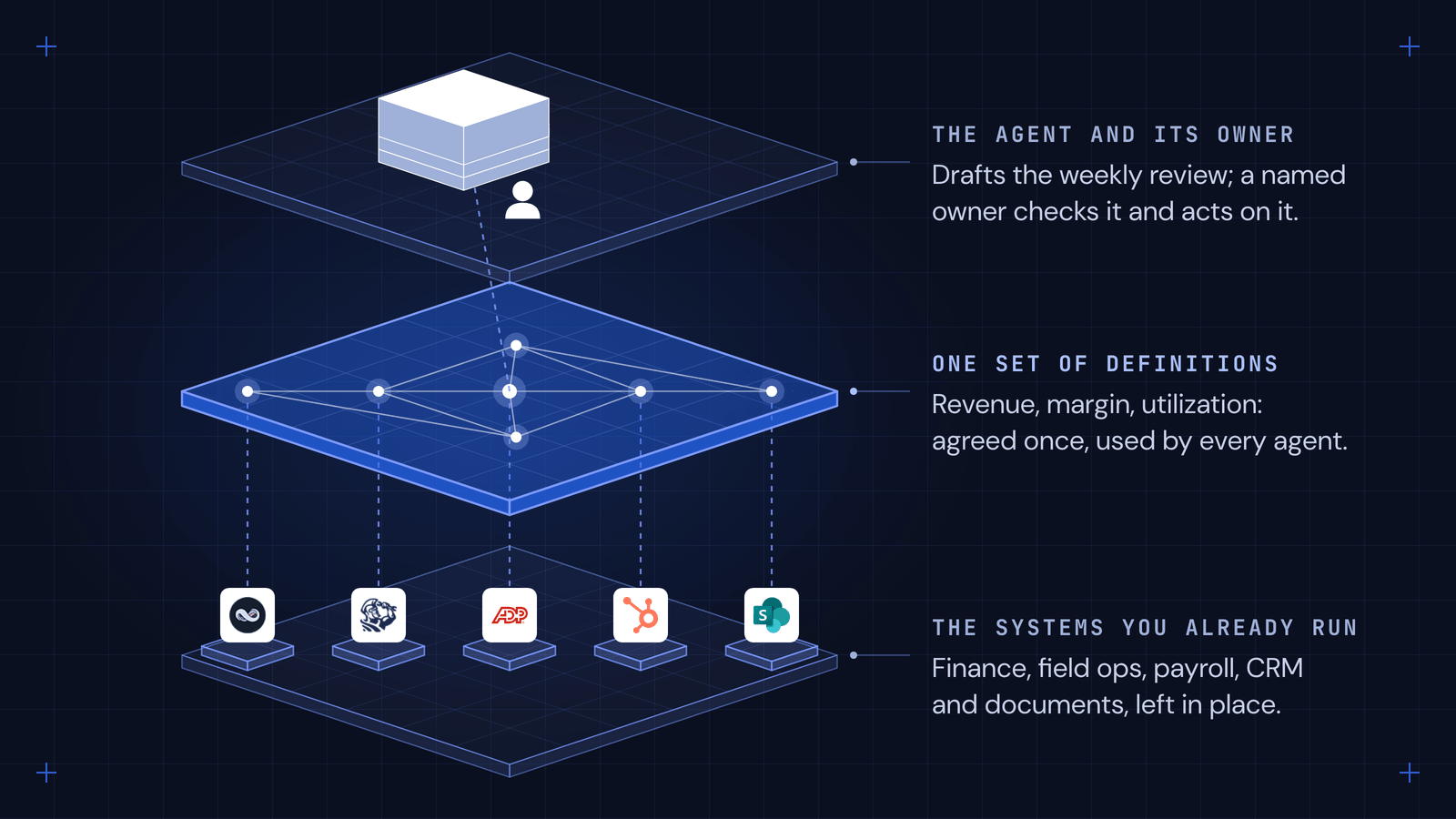
If finance counts revenue on invoice and operations on job completion, an AI answer starts an argument about the number. Agree definitions once in a shared model of the business, or ontology, that every agent reads. Our company ontology guide and why AI needs a system of record explain how the AI knows which version to trust.
4. Nobody runs it after launch. Gartner’s June 2025 cancellation forecast cited “escalating costs, unclear business value or inadequate risk controls.” Anushree Verma, Senior Director Analyst, said: “This can blind organizations to the real cost and complexity of deploying AI agents at scale, stalling projects from moving into production.” Source systems change, providers retire models and new service lines change definitions. Upkeep needs an owner and budget before launch. Settle what happens to our AI systems when the engineers leave at the start.
What do the AI pilots that reach production do differently?
Start with a recurring decision, then settle the four drop-off points before building. Choose accounts for billing review, find underused crews or prepare Monday’s leadership decisions. Redesign that work around the AI.
MIT NANDA’s July 2025 interviews found external partnerships reached deployment about 67% of the time versus 33% for internal builds. These were self-reported results from 52 interviews. Mid-market top performers averaged 90 days from pilot to full implementation; enterprises took nine months or longer. Narrow scope gives the team a defined finish.
In our work with a PE-backed field services company, the team first connected the data warehouse, finance, billing, HR and customer contracts into one model. A contract review application compared agreements with actual billing and flagged pricing differences. A crew productivity view gave operations and finance shared numbers. An agent prepared the weekly operations review. Each served a recurring decision with an owner and landed in an existing review or leadership meeting.
What do the numbers not tell us?
These studies cannot tell you whether your AI pilot deserves another round of funding. The figures are surveys or predictions, mostly self-reported; MIT calls its small sample directional. Few separate mid-market companies from enterprises. RSM does, but defines the middle market as $30 million to $10 billion in US revenue, wider than most readers mean. None says how many abandoned pilots deserved to stop or whether their use cases justified the attempt. A pilot that shows a workflow is not worth automating has saved money.
When is a custom AI pilot the wrong choice?
Buy AI for self-contained tasks; wait if nobody owns the outcome. Meeting notes, email drafts and document searches suit ChatGPT Enterprise, Claude for Work or Microsoft 365 Copilot. Start there for a faster, cheaper route than a custom build. If the decision happens once a year, do not automate it.
Build in-house when engineers have time and access to the business; our build vs buy post covers the trade-offs. Use a consultancy for strategy or a one-off analysis. Match the approach to the work:
| Approach | Best for |
|---|---|
 ChatGPT Enterprise or  Claude for Work |
Individual tasks: drafting, summarizing, searching documents. Little to connect, nothing to hand over |
| A packaged AI feature in software you already run | One task inside one system, such as invoice matching in the ERP or scheduling in the field service platform |
| An internal engineering team | Companies with engineers who have time, access to the business and someone to own the result |
| A consultancy | A strategy question, a roadmap or a one-off analysis |
| Forward-deployed engineers | Recurring decisions that draw on several systems and need to run in production every week |
What should you ask before approving the next AI pilot?
An AI pilot needs an agreed route to production before it gets funded. Take these questions to the leadership meeting or vendor:
- Which recurring decision does this improve, and how often does it come around?
- Who owns the outcome, and which of their KPIs should move?
- What is the baseline today, and what result by what date would count as success?
- Where will the output appear: which meeting, report or system?
- Which systems does it read from, and who has agreed the definitions of the numbers it uses?
- What is the production date, and what happens to the pilot if it is missed?
- Who runs it after launch, and what is the monthly run cost?
- If the vendor or the builders leave, what do we own and who can change it?
How does DealSage get AI pilots into production?
DealSage brings a company’s data, decisions and operations into one model of the business. Our forward-deployed engineers then build the workflows, agents and apps on top and stay until they run in production. We agree the recurring decision, the owner, the production date and who runs it afterward before we build. We work with mid-market companies and the investment firms that back them, together or on their own. DealSage was built by alumni of J.P. Morgan and Palantir and is not affiliated with Palantir. To fix a stalled pilot or settle the four drop-off points, talk to us or read our guide to forward-deployed engineering.
Frequently asked questions
- What percentage of AI pilots fail?
- AI pilot failure rates depend on the measure: IDC (March 2025) found 88% of proofs of concept did not reach wide deployment; S&P Global (March 2025) found the average company scrapped 46% of its proofs of concept before production; MIT NANDA (July 2025) found 95% of organizations saw no measurable return.
- Is the 95% figure from MIT reliable?
- MIT NANDA's July 2025 figure is directional, based on over 300 public initiatives, interviews with 52 organizations and a survey of 153 senior leaders. It measures profit impact, a higher bar than production, and relies on interviews rather than official company reporting.
- What is the difference between an AI pilot and production?
- A pilot tests AI on real data with a small group. Production means people use it whenever the task recurs, in their existing systems and meetings, with an owner, a known monthly cost and a measured outcome.
- Is it better to buy AI or build it in-house?
- Buy for self-contained tasks. For work spanning systems, MIT NANDA (July 2025) reported deployment rates of roughly 67% for external partnerships versus 33% for internal builds, about twice as often, based on a small, self-reported interview sample.
- How long should an AI pilot take to reach production?
- MIT NANDA (July 2025) found mid-market top performers averaged about 90 days from pilot to full implementation, versus nine months or longer at large enterprises. Agree a production date and owner before starting.
- Should we stop running AI pilots?
- Keep running AI pilots, but give each an exit: a decision, owner, KPI, destination for its output and plan for upkeep. A pilot that fails that test early has done its job.
- Do we need clean data before starting an AI pilot?
- Agree definitions for the few numbers the first workflow uses, such as revenue, margin or utilization, before building. A company-wide cleanup is unnecessary; Gartner (February 2025) predicted 60% of AI projects unsupported by AI-ready data would be abandoned through 2026.
Part of the guide: read the full guide
See it on your own business.
We connect the systems you already run into one model of the business, then embed engineers to build the AI your team uses. Start with one decision.