
What happens to our AI systems when the engineers leave?
Receiving a GitHub repository at the end of an engagement does not mean you can run the system. Real operational continuity comes down to where your ERP business logic lives and who owns the Monday morning exception queue.
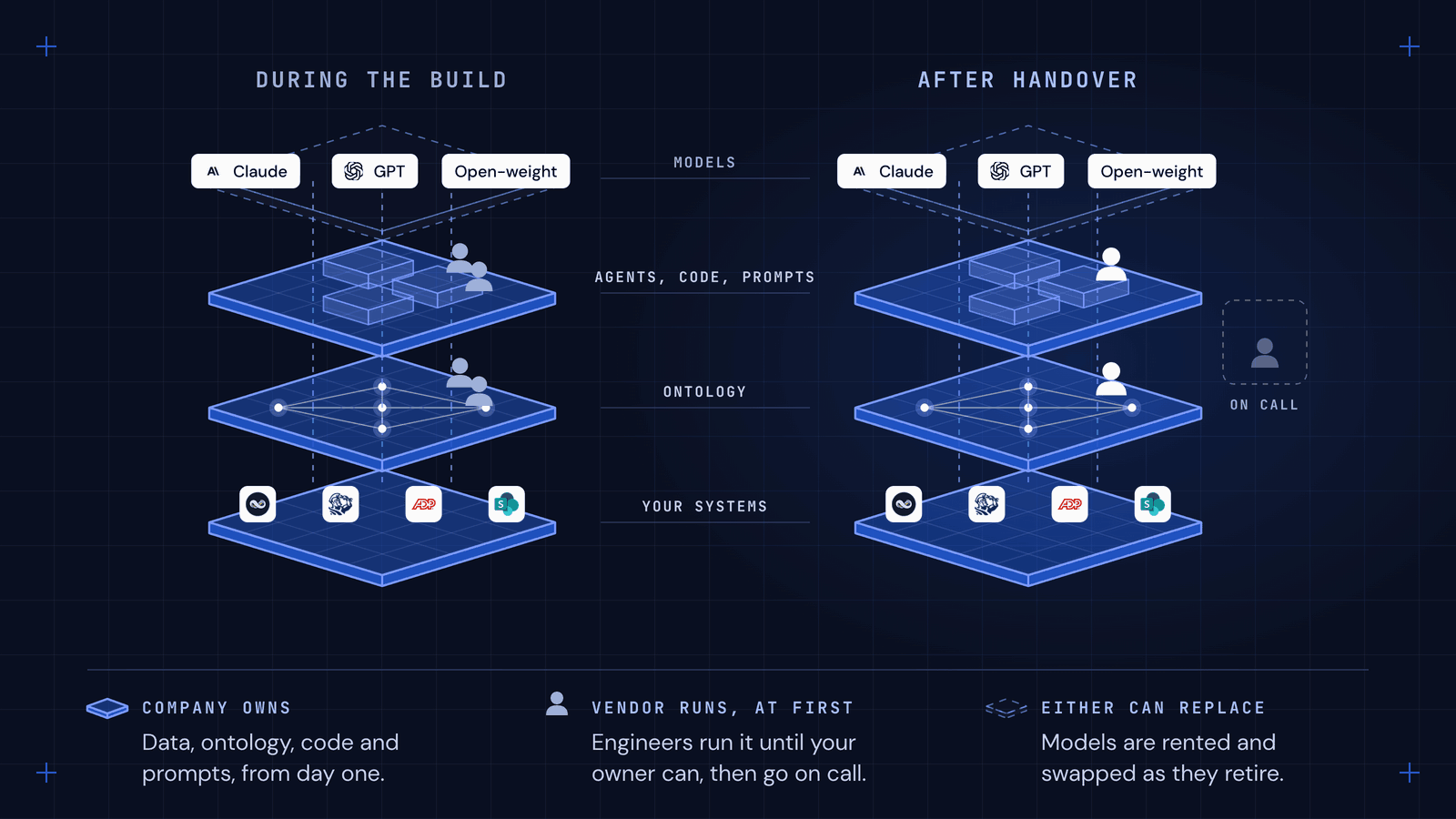
When outside engineers finish building an AI system and walk out the door, the system rarely breaks because an AI model changed. It breaks on a Monday morning six weeks later, when the CFO changes a customer rebate tier, a regional manager overrides a branch job code, or the controller adds two general ledger accounts in NetSuite, and nobody left inside the company knows where those rules were hardcoded.
Every CEO, CFO, and operating partner hiring an external team to build AI workflows asks some version of this question. They have seen the movie before with custom ERP consultants and boutique data shops: six months of billable hours, a polished demo on Friday, and a system that quietly dies in production the moment the builders roll off.
The usual legal answer is to demand intellectual property assignment and a GitHub repository in your company’s name. You should demand both, and neither will save you on its own. For a $90M industrial distributor or a multi-branch services company without a ten-person internal software team, a repository of undocumented Python scripts and prompt templates might as well be a locked black box.
Real continuity after the engineers leave depends on three operational questions:
- Where does your undocumented ERP business logic live? Is it buried inside application code and prompts, or mapped explicitly in a company ontology that a controller or VP of Operations can read?
- What happens when a branch manager or sales director breaks the standard process? Does the system silently produce a wrong margin number, crash, or route the anomaly into an inspectable exception queue?
- Who owns the Monday morning exception queue? Is there a named person inside the business who knows how to clear a flagged transaction in ten minutes without opening a support ticket?
Why “owning the code” fails the Monday morning test
In a mid-market company, the official schema inside  NetSuite,
 Salesforce, or
 ServiceTitan is never the whole truth of how the business runs. The real logic lives in the compromises accumulated over ten years of acquisitions, regional carve-outs, and handshake commercial deals.
Consider how gross margin actually gets calculated at a multi-branch industrial distributor running on NetSuite:
- Custom customer margin and rebate rules: The top forty national accounts have volume rebate tiers that reset quarterly, plus freight allowances that only trigger when an order ships from a primary regional warehouse rather than a satellite branch. Half of those rebate agreements live as PDF addenda in SharePoint or as a tab in the controller’s month-end workbook.
- Branch manager job-code overrides: When a branch is short on a standard assembly or a technician logs expedited warranty rework, the branch manager overrides the default job or item code in the ERP so the shipment goes out on time. To the raw database table, that override looks like a 92% margin order or an unbilled cost center until accounting manually reclassifies it at month-end.
- Inter-branch transfers and acquisitive chart-of-accounts drift: Two branches acquired last year still book freight-in and vendor rebates to legacy account numbers that do not match the parent chart of accounts.
When a typical consultancy or AI agency builds an automated margin-monitoring or quoting agent, their engineers sit with your controller for two weeks, learn those quirks, and hardcode them directly into SQL views, Python transforms, and 1,500-word LLM system prompts.
On day one, the demo looks magical. On day forty-five, after the engineers have moved to their next client, the commercial team signs a new tiered rebate structure with a major buying group, and the Phoenix branch manager introduces a new job-code prefix for emergency weekend dispatch. Because those rules were baked into code nobody inside the company can read, the AI agent keeps applying last quarter’s logic. By month-end, the automated weekly margin report is off by $140,000 against the controller’s close. Once the CFO catches a single unexplained variance, trust evaporates and the team goes back to spreadsheets.
Code handoff vs. operational handover: the three layers you must separate
To prevent a system from decaying the week after handover, you have to separate how the software executes from how the business defines its rules. That separation has three distinct layers:
| Layer | What goes wrong when engineers hardcode it | How it works when structured for handover | Who owns it after handover |
|---|---|---|---|
| 1. ERP & commercial business logic (Company Ontology) | Customer rebate tiers, GL roll-ups, and branch job-code mappings are buried inside SQL scripts and LLM prompts. Only an engineer can change them. | Definitions, source mappings, and commercial rules live in an inspectable ontology layer. Every metric links back to the exact NetSuite, CRM, or payroll field. | Controller / VP of Operations (reviews definitions, updates commercial tiers, approves new mappings). |
| 2. The Monday morning exception queue | Unrecognized job codes, missing PO links, or off-sheet customer discounts either crash the pipeline or get silently guessed by the model. | Any record that violates a schema rule or falls outside historical confidence bounds is quarantined into a Monday exception queue with the exact source row attached. | Operational owner (clears or reclassifies flagged items in 15 minutes during the Monday review). |
| 3. Execution code, prompts & model routing | Hosted inside the vendor’s private account with no versioned evaluation suite; swapping models or prompts breaks downstream formatting. | Stored in your company’s own GitHub repository, running on cloud accounts and API keys you control, backed by 50 to 100 real historical test cases. | Internal technical lead or retained FDE partner (maintains connectors, runs test suites on changes). |
How the Monday morning exception queue actually keeps AI alive
The single most reliable predictor of whether an AI system is still running six months after the engineers leave is whether the builders designed an exception queue for the human operator.
In a live business, data is never permanently clean. Sales reps leave fields blank, branch managers invent shorthand codes to get trucks out the door, and suppliers change invoice layouts without warning. If an AI system is built on the assumption that inputs will always match the schema from week four of the engagement, it is brittle by design.
A durable system treats exceptions as a normal weekly workflow rather than a software bug:
- Quarantine, do not hallucinate: When the system encounters an unmapped NetSuite GL account, a branch job-code override that lacks a cost-center tag, or a customer invoice whose rebate calculation diverges from the contract table on file, it does not guess. It flags the specific transaction and holds it in the exception queue.
- Show the lineage side by side: When the controller opens the queue on Monday at 8:00 AM, each flagged item shows the exact source record (for example, NetSuite invoice
#INV-40918, branchDAL-02, override codeWR-EXP), the rule that tripped, and the proposed classification. See Show Your Workings: Why AI Without Data Lineage Fails the IC Test for how lineage prevents black-box mistrust. - Turn resolutions into durable rules: When the controller resolves the exception, confirming that
WR-EXPat the Dallas branch should map to expedited warranty COGS rather than billable installation margin, that decision updates the ontology mapping table directly. Next Monday, the system handles that code automatically without an engineer writing a line of Python.
In our work with a multi-branch industrial distributor running on NetSuite, the quoting and margin-reconciliation workflow originally depended on a senior financial analyst who spent fourteen hours every week manually matching branch-level price overrides and vendor rebate chargebacks against the general ledger. When forward-deployed engineers wired NetSuite, the warehouse management system, and the customer rebate tables into a single ontology, they did not hide the rebate tiers inside prompt text. They exposed the rebate rules and branch override mappings as an inspectable table owned by the controller, paired with a Monday exception queue for unmapped SKU substitutions and off-sheet discounts. When the build team stepped back, the controller’s team could onboard a new customer rebate schedule or resolve a branch job-code anomaly in ten minutes without touching code.
What a real handover pack contains
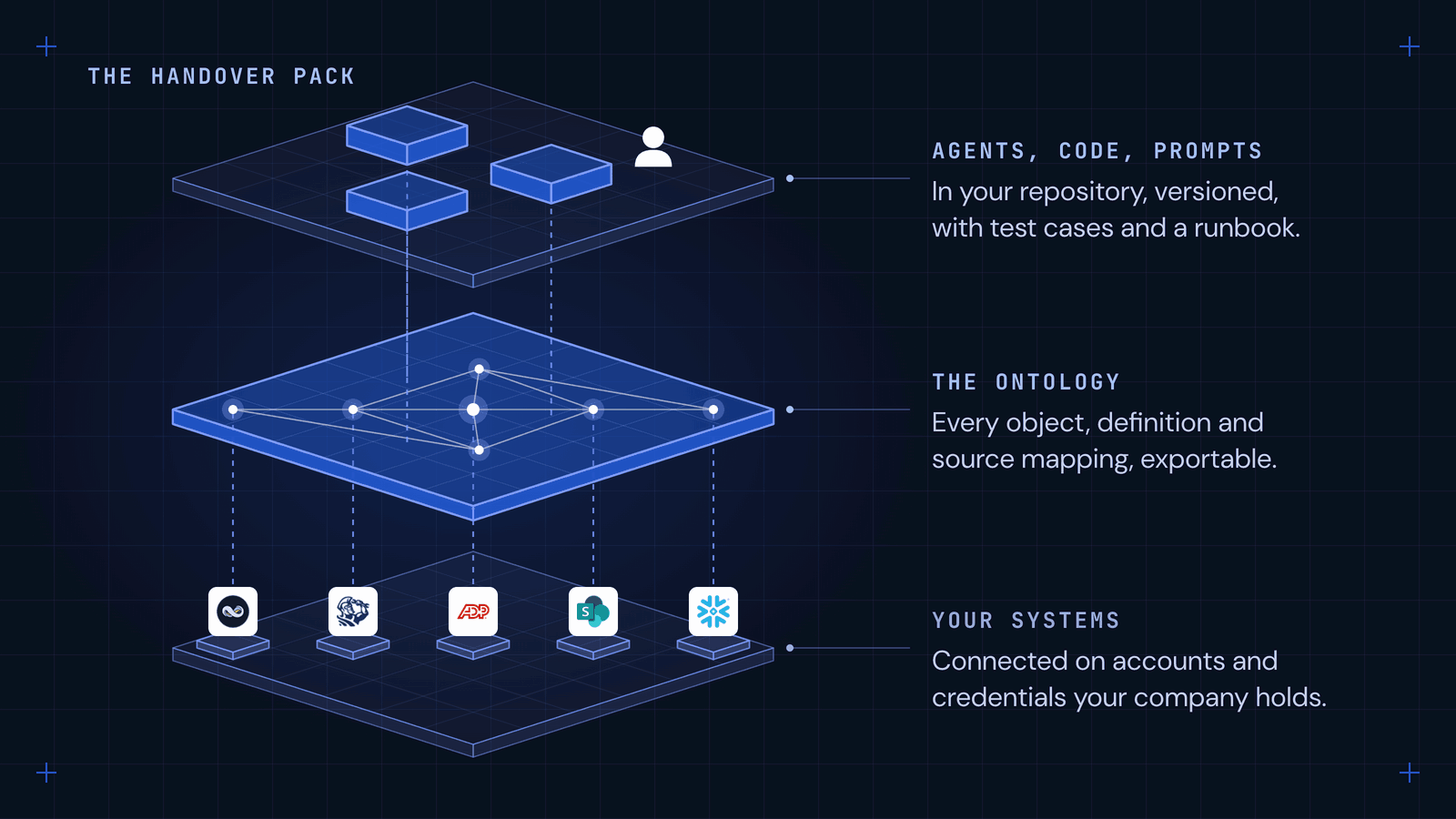
Before the final milestone payment of any AI build, require a physical handover pack tested by the person who will run the system on Monday morning. A folder of architecture slide decks does not count. The pack needs five concrete artifacts:
1. The business-logic and ontology dictionary
An exportable, plain-English registry of every core object (Customer, Branch, Job, Invoice, Rebate Tier), every calculated metric (Net Pocket Margin, Earned Rebate Accrual, Billable Utilization), and the exact source table and field in NetSuite, Salesforce, ServiceTitan, or ADP that feeds it. Crucially, it must list every exclusion rule and override (for example, which inter-company accounts are stripped out of consolidated revenue and how branch warranty overrides are treated).
2. The Monday morning exception runbook
A two-page operational guide written for the controller, FP&A lead, or VP of Operations, not for a software engineer. It explains:
- Where the exception queue lives and when the weekly sync runs.
- The four or five most common exceptions (new GL account, unmapped job code, expired customer rebate table, missing PO reference) and how to clear each one.
- How to verify that the weekly agent output reconciles to the ERP trial balance in under five minutes.
- What constitutes a true infrastructure failure that requires calling technical support.
3. The code repository, credentials, and cloud tenancy in your name
All orchestration code, SQL transforms, and versioned prompts should live in your company’s own GitHub or GitLab organization from week one, not copied over in a zip file on the last day. The database, warehouse ( Snowflake, BigQuery, or Postgres), and model API keys (
 Anthropic,
 OpenAI) should run on accounts owned by your company so nobody can hold your pipelines hostage over a contract dispute.
4. The historical regression test suite
At least 50 to 100 real historical cases drawn from your own business, including the messy ones: retroactive credit memos, split-branch shipments, partial rebate clawbacks, and job-code overrides, paired with the verified correct output. Whenever an engineer or internal analyst updates a prompt, changes a calculation rule, or swaps an underlying model, they run those 100 cases first to prove nothing silently broke.
5. Named ownership and escalation boundaries
A one-page table naming the internal business owner for each workflow, the internal technical administrator who holds repository and credential access, and the SLA if you retain the vendor on a lightweight support agreement for schema changes or new M&A integrations.
When custom forward-deployed builds are the wrong choice
You only have to worry about engineer handover when a workflow is built around your company’s proprietary operating logic. Plenty of problems do not need custom engineering at all:
- Standard departmental SaaS workflows: If you need call transcription, basic CRM email drafting, or standard AP invoice OCR with no complex multi-branch rebate or job-costing logic, buy an off-the-shelf SaaS product where the vendor maintains the software for thousands of customers identically. See our breakdown of Build vs. Buy for AI in the Middle Market.
- No internal owner willing to hold the wheel: If neither the controller, the VP of Operations, nor an operating partner is willing to spend thirty minutes on Monday morning reviewing the exception queue and owning the business definitions, do not commission a custom build yet. An unowned operational system will drift regardless of how well the engineers built it.
- Unstable ERP migration in progress: If the company is mid-cutover from a legacy on-premise ERP to NetSuite over the next ninety days, wait until the chart of accounts and item master stabilize, or use the ontology build specifically to map the legacy schema into the new one.
Eight questions to ask before the engineers start, and before they leave
Take this checklist into the vendor kickoff and use it as the sign-off gate before final handover:
- Where do our customer rebate tiers, margin rules, and branch overrides live? Show me where a controller or ops lead can read and update a commercial rule without editing Python or prompt text.
- What happens on Monday morning when a branch manager enters an unmapped job code or a new GL account appears in NetSuite? Show me the exception queue and how the system flags the record instead of guessing.
- Does every AI-generated number link back to the underlying ERP rows? Can our CFO click a margin variance and see the exact NetSuite invoice IDs and rebate rules behind it?
- Whose GitHub organization and cloud accounts are you building in on day one? Confirm that the code, prompts, and data pipelines run in our tenancy from the start.
- What is in the regression test suite? Show me the 50 to 100 messy historical transactions from our own ledger that verify the system still calculates accurately after a change.
- Who is the named Monday morning owner inside our company? Have they run the workflow and cleared the exception queue themselves for two consecutive weeks while your engineers watched without touching the keyboard?
- What can we export if we ever part ways? Confirm that every entity definition, SQL transform, source-to-target mapping, and historical log exports in standard SQL, JSON, or Parquet.
- What happens when we acquire another branch or bolt-on company six months from now? What can our team map ourselves, and what does it cost to bring a forward-deployed engineer back for two weeks to wire in a new ERP?
How DealSage handles ownership and handover
DealSage is built by alumni of J.P. Morgan and Palantir to give mid-market companies and their sponsors a durable company ontology paired with forward-deployed engineers who wire NetSuite, CRM, field-service, and payroll systems into working production workflows. Your business definitions, customer rebate logic, and ERP mappings live in an explicit, inspectable model rather than hidden scripts, and every workflow includes a Monday exception queue trained with your controller or operations lead before our engineers step back. If you want to review how handover and ongoing support work for your company or portfolio, get in touch.
Frequently asked questions
- If the contract says we own the GitHub repository, why would we still be locked in?
- Because a repository full of scripts does not document why your business works the way it does. When a branch manager introduces a new job-code override or the CFO restructures Q4 customer rebate tiers, an internal finance team cannot safely edit 4,000 lines of undocumented orchestration code. Without a plain-English ontology layer separating business rules from code, the system goes stale within one quarter.
- What actually breaks first when outside AI engineers leave a mid-market company?
- Edge cases in the ERP and CRM break first. A new general ledger account gets added in NetSuite, a regional sales director approves an off-sheet rebate for a top distributor account, or a branch reclassifies warranty labor. If those exceptions are not routed to a clear Monday morning exception queue owned by an internal controller or ops lead, people stop trusting the numbers and revert to Excel.
- Who inside a mid-market company should own an AI workflow after handover?
- The operator who already owns the underlying decision, not an IT helpdesk ticket queue. The controller should own close and margin-reconciliation agents; the VP of Operations should own dispatch, inventory, and scheduling workflows. Their job is not to maintain infrastructure, but to review flagged exceptions and approve rule updates when the business changes.
- How should business rules like customer rebates and branch overrides be stored so our team can maintain them?
- They should live in a shared company ontology rather than inside prompts or Python scripts. Every entity (Customer, Branch, SKU, Rebate Tier, Job Code) and every calculation rule should be defined once, linked directly to the source fields in NetSuite, Salesforce, or ServiceTitan, and exposed so a finance or ops lead can inspect the lineage of any number.
- What is the practical test that an AI system is ready for the engineers to step back?
- Run a two-week live shadow period where your internal owner handles the Monday morning exception queue, resolves unmapped ERP codes, updates at least one commercial rule (such as a customer rebate threshold), and verifies the output against the general ledger without the vendor touching the keyboard.
- When should we keep forward-deployed engineers on call instead of running everything in-house?
- Keep your internal team in charge of daily runs, exception queues, and commercial rule changes, and keep forward-deployed engineers on a light retainer for structural changes: integrating a newly acquired company's ERP, building a new agent workflow, or rewiring pipelines after a major schema migration.
Part of the guide: read the full guide
See it on your own business.
We connect the systems you already run into one model of the business, then embed engineers to build the AI your team uses. Start with one decision.