Build vs Buy AI: Why Mid-Market Companies Need a Third Option
Building in-house is cheaper than it has ever been, and buying is easier than ever. Most mid-market companies still end up with pilots that never reach production. The answer is a third option.
After a company’s first good result with AI, someone in leadership usually makes the same suggestion: hire an engineer or two and build our own. When I wrote the first version of this piece in May, my advice was simple: don’t build, buy. Six months of working inside mid-market companies has changed my view. I still think building is usually a mistake. But buying software and handing it to the team usually fails too. I now recommend a third option.
Should you build your own AI tools?
Usually not on your own. Building made sense when your problem was unique and nothing on the market solved it. Those cases are rarer now, but falling development costs have made building more tempting. McKinsey’s 2026 State of AI survey found 32% of companies had decided against buying software because they could build it themselves with AI coding tools.
The cost of writing code was never the main obstacle. I spent a decade at J.P. Morgan and watched the bank try to build its own version of nearly everything: a terminal to rival Bloomberg, an internal chat to rival Slack, its own chatbot, its own deal-sourcing platform. Most were eventually dropped in favor of a better outside product. The bank spent well over $20bn a year on technology. It could hardly plead a lack of money.
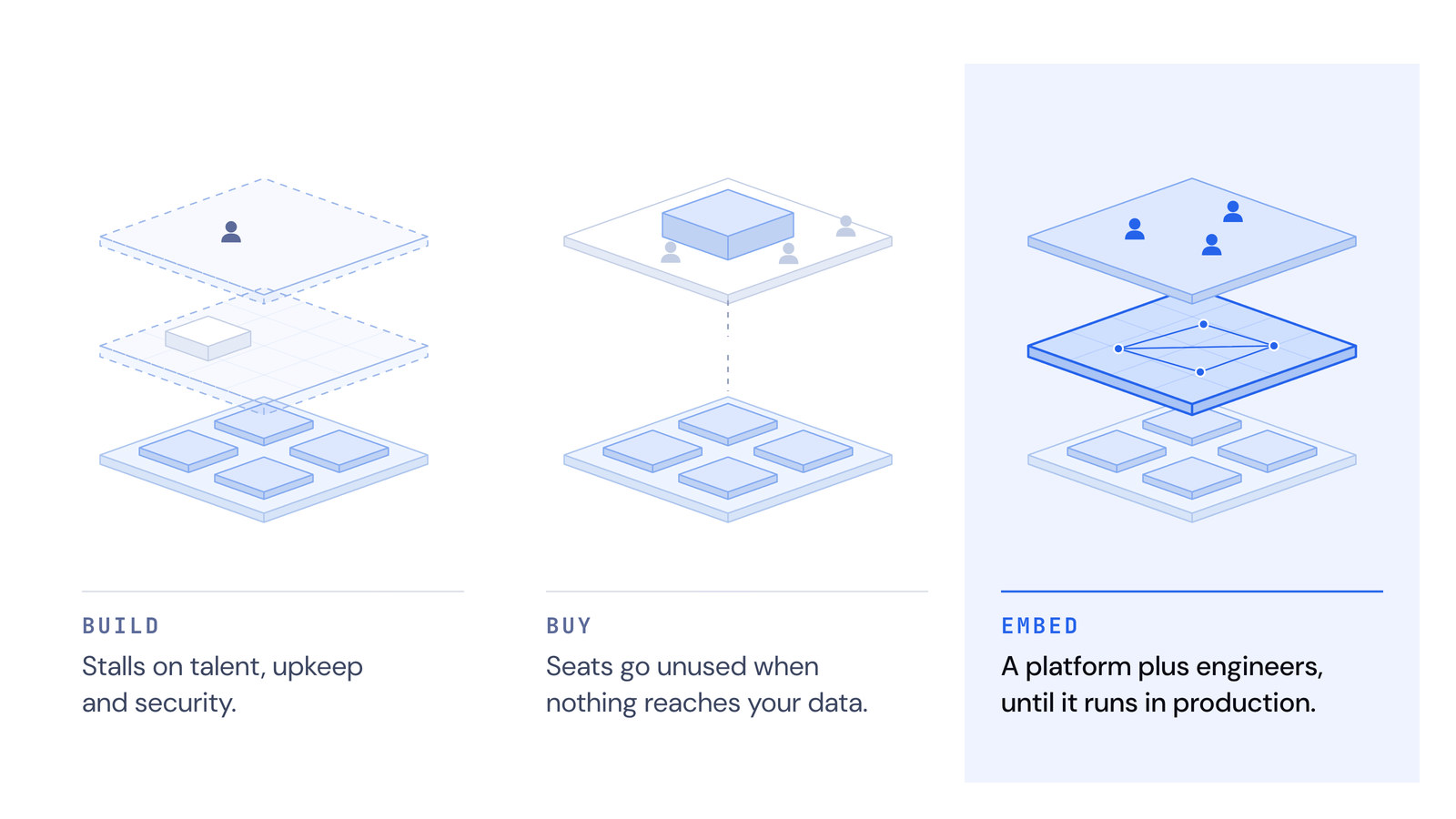
Mid-market companies usually lack the team to turn a working demo into a system the business can depend on. Building is cheap. Getting that system into production and keeping it running is still expensive. That is where in-house projects stall. MIT’s July 2025 study of enterprise AI, “The GenAI Divide”, found that internally built tools reached deployment only about a third of the time.
What does building actually cost?
I would budget for the work that continues long after the first build.
Talent. Engineers who can build agentic systems that hold up in production are scarce, and the frontier labs pay seven figures for them. Hiring one or two leaves the company dependent on a very small team.
Maintenance. Models change every few months. Retrieval needs retuning, integrations break when a vendor ships an update, and security needs regular review. When the engineer who built the system leaves, the knowledge of how it works can leave too.
Security. A custom-built system with access to the company’s contracts, financials and email is a liability unless someone who specializes in securing these systems has reviewed it.
Focus. Running the business is already a full-time job. Building an AI platform properly is another. Squeezed around everything else, it gets done slowly, badly or both.
Then why not just buy?
Buying comes with a familiar problem. A company buys seats, announces an AI rollout, and six months later usage has faded. In a 2024 Gartner survey of IT leaders, 60% were piloting Microsoft 365 Copilot but only 6% had finished a pilot and were planning a large deployment. Seventy-two percent said employees struggled to fit it into their daily work.
Generic tools are good at generic work: drafting, summarizing, searching. The decisions that matter to a mid-market company depend on its own data: which jobs are running over budget, which customers are likely to churn, where margin is leaking between the contract and the invoice. The answers sit across the ERP, the CRM, the billing system, spreadsheets and people’s heads. None of these systems talk to each other. A tool that cannot access that data cannot help with those decisions, however good the model behind it is.
RSM’s 2026 survey of middle market companies puts numbers to the problem. Among companies whose AI pilots had only moderate or limited success, the biggest barriers to scaling were data quality (53%) and integration (47%). That is where I would focus the work.
What is the third option?
I call it embedding. The company works with a partner that brings a platform and engineers who work alongside its team. Those engineers connect the company’s systems, build one model of the business across them, and develop the apps and agents the team uses every day. They stay until the work runs in production.
Palantir built its business on this approach, called forward-deployed engineering. For a long time, it was available only to governments and the largest enterprises. The approach is now spreading quickly: OpenAI, Anthropic and Cohere have all built forward-deployed teams, and job listings for the role have grown many times over since 2024.
To me, the evidence for this approach is the strongest in the build vs buy debate. In the same MIT study, tools built through external partnerships reached deployment about two-thirds of the time, twice the rate of internal builds. The study described the successful buyers as acting “like BPO clients, not SaaS customers”, and concluded that crossing the divide “requires partnership, not just purchase”. MIT is careful to say its results are self-reported and do not prove causation, but the gap is large.
Why does embedding suit mid-market companies?
Mid-market companies can move fast. MIT found top performers took about 90 days from pilot to full implementation, against nine months or more at large enterprises. They have fewer systems, shorter decision chains and leaders close enough to the work to know what matters.
They usually lack the integration team that large enterprises keep on staff. An embedded partner provides that team for as long as the work requires. The company keeps what gets built: the connected data, the definitions, the apps and the agents.
Embedding also changes where I would start. Rather than spend a year on data cleanup before beginning an AI project, I would pick one decision the business makes every week, connect the systems it depends on, and build the tool that supports it. The cleanup happens as part of that work. The second project builds on the first.
How should you decide?
This is the test I would use for most companies.
| If the work is… | Then |
|---|---|
| Generic (drafting, summarizing, research) | Buy a general tool and train people to use it |
| Specific to your data and workflows, and you have a production engineering team | Build, with a clear plan for maintenance and security |
| Specific to your data and workflows, and you do not have that team | Embed: platform plus engineers until it runs in production |
Most mid-market companies fall into the third row for the work that matters most. That is what we do at DealSage. We connect a company’s systems into one model of the business and embed engineers with its team to build what it needs. See how it works, read what it looks like in practice, or explore the options in our guide to Palantir alternatives for mid-market companies. I run a company in this space, so weigh my view accordingly. The MIT and RSM numbers are not mine.
What about investment firms?
The same logic applies to the firms that back these companies, which is where this piece started. Private equity firms that tried to build their own AI tools ran into the same problems. I see a bigger opportunity in bringing this approach to their portfolio companies. Our guide to AI for investment firms covers that side.
After the first good result, I would judge the next project by how well it uses the company’s own data to improve a decision the business makes every week. That is where the engineering effort and budget earn their keep.
Frequently asked questions
- Should a mid-market company build its own AI tools?
- Rarely on its own. Coding agents have made building cheaper, but getting a system into production still needs engineers who can connect the company's data, secure it and keep it running as models change. Most mid-market companies do not have that team and should not have to hire one to get started.
- Is buying AI software better than building it?
- Buying beats building when the problem is generic, such as drafting emails or summarizing calls. For work that depends on the company's own data and processes, an off-the-shelf tool tends to sit unused, because nobody has connected it to the systems the work actually runs on.
- What is the third option between build and buy?
- Embed. The company works with a partner that brings a platform and engineers who sit with the team, connect its systems into one model of the business, and build the apps and agents it needs on top. The partner stays until the work runs in production. This is the forward-deployed model Palantir made famous, sized for the middle market.
- Why do AI pilots fail to reach production?
- Mostly because of the data. In RSM's 2026 survey of middle market companies, firms whose pilots struggled named data quality (53%) and integration (47%) as the main barriers to scaling. The model is rarely the problem. Getting the right data in front of it, inside a real workflow, is.
- How much does it cost to build AI in-house?
- The first build is the cheap part. The ongoing cost is the infrastructure, model upgrades every few months, security reviews, and the knowledge that leaves when the one or two engineers who built the system move on.
- Do mid-market companies move faster on AI than large enterprises?
- They can. MIT's 2025 study found top-performing mid-market companies took about 90 days from pilot to full implementation, against nine months or more at large enterprises. Fewer systems and shorter decision chains help, as long as someone does the integration work.
Get this thinking weekly.
Acquisition Intelligence is a weekly read on AI in M&A for deal-makers. No fluff, no hype.