
When the KPI Becomes the Business
A target gets hundreds of people moving the same way. The same alignment makes it expensive to change direction when conditions change, and that cost is what AI can bring down.
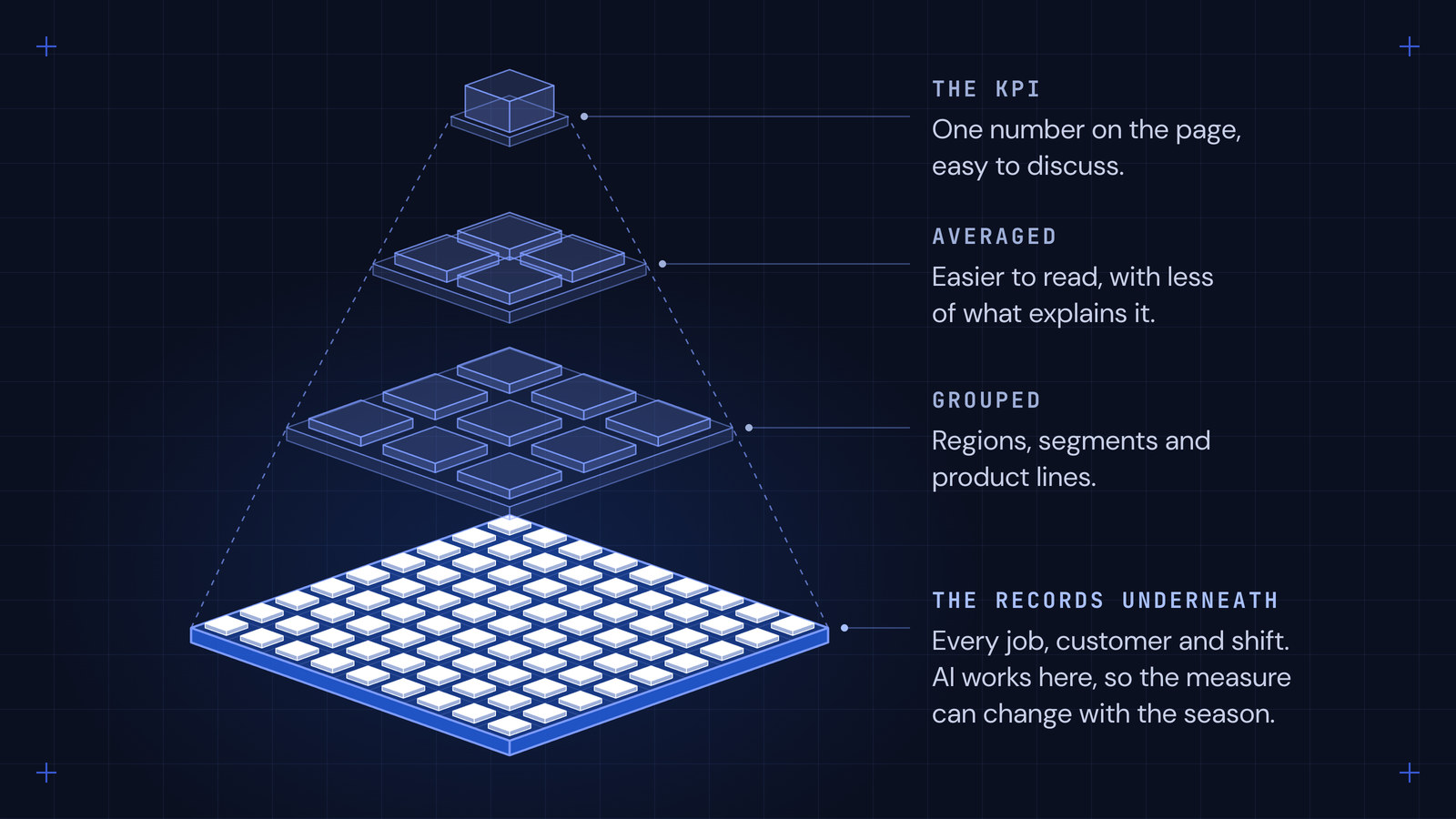
A KPI makes a complicated business manageable by reducing it to a handful of numbers people can track and compare. Once the organization starts steering by those numbers, they become hard to change: targets, budgets, bonuses and weekly routines all form around them, and that alignment turns into inertia when conditions shift. AI working across the records underneath the numbers lowers the cost of changing course, because the detail the KPI removed is still available and the work of re-explaining a new priority shrinks.
A familiar pattern in operating businesses
One business we worked with had revenue arriving broadly as expected while profit kept falling short. It tracked how much work came in and how much got completed, which is sensible when customers expect jobs finished on time. Completing the work often meant weekends and overtime, and the volume figures had no way of showing what that cost to deliver.
Nothing in the reporting was wrong. The measures were simply built for a period when the business was filling spare capacity, and capacity had since become tight.
What a KPI removes
A regional manager cannot inspect every job, read every contract and hold the payroll calculation in their head. A partner overseeing several portfolio companies has even less chance. So the business gets grouped, normalized and averaged into a compact picture with a set of targets to orient around.
Underneath, the precision is thinner than it looks. “Productivity” depends on which work is counted and whose hours are included. Two divisions can report the same KPI with different exclusions and adjustments, each of which made sense to the person who introduced it. Every round of averaging makes the business easier to discuss and removes some of the detail that explains how it actually runs.
How alignment becomes inertia
A KPI acquires an owner, a target and a place in the weekly meeting. It finds its way into budgets and bonuses, and managers build routines around delivering it. Over time a large share of the company’s effort goes into improving something that began as an approximation of how well it was doing.
That alignment is valuable. Getting hundreds of people moving in roughly the same direction is difficult, and a clear target helps. The cost appears when the business needs to change direction. A push for volume can outlive the margins that justified it. A utilization target set while filling spare capacity keeps driving behavior after capacity is stretched.
Reversing it means revisiting targets, explaining new priorities and persuading people that last quarter’s rewarded behavior should now change. Much of the rigidity is simply the effort required to make a new direction understandable to everyone involved.
What AI changes
Most management systems are designed around the amount of complexity people can absorb: categories people can remember, averages they can compare and a manageable number of priorities. Changing the framework is expensive once the whole company has learned to operate through it.
A system working across the underlying records, contracts and operating history does not need the business compressed in the same way. With reliable, connected data it can investigate relationships between parts of the business that nobody put in the reporting template. A falling margin might connect to customer mix, a scheduling decision in another region or an exception buried in a contract, each of which looks unremarkable in the report owned by the team responsible for it. (We described how meaning is lost as numbers pass between teams in The Company Is the Dataroom.)
Three practical consequences follow:
- Relationships can be investigated without becoming permanent KPIs. A suspected driver can be tested against the records rather than added to the monthly pack for someone to report indefinitely.
- The measures guiding current decisions can change with conditions. During a seasonal peak, fulfilling commitments and protecting scarce capacity may dominate. In a quieter period the emphasis can move to customer economics or releasing cash tied up in operations.
- The change is cheaper to carry through. The same records support the revised analysis, the system can identify where existing targets conflict with the new priority, and each team can see what the change means for its own decisions.
Managers still agree the trade-offs and change incentives where necessary. Less of the transition depends on rebuilding reports and passing explanations down a long chain.
An operating example
In a PE-backed, multi-region services business, operating, billing and accounting systems never reconciled, so problems surfaced in the monthly review weeks after they could have been fixed. We reconciled those systems into one foundation and put demand, margin and risk models on top, with a daily dashboard in place of the monthly deck. Quality and billing incidents are down 30 percent, and staffing is set by coming demand rather than last period’s volume. The measures the regional teams watch can shift with the season because they are calculated from the same records each time.
Keeping flexible measures accountable
Flexibility needs a memory. When a priority changes, the reason should be recorded, the previous measures kept and the results followed up. Without that record it becomes easy to redefine success whenever a result disappoints.
The same applies to recommendations that look strange through the measures people have been trained to improve. A system that considers more relationships than a person can hold will sometimes reach conclusions that are hard to follow. The answer is to interrogate them: see the evidence, understand which assumptions drive the result and check whether the expected outcome appears. The company also has to stay explicit about what it is trying to achieve, because more information cannot decide how much a customer relationship is worth or which risks are acceptable.
Giving the numbers another dimension
Companies will still need indicators to track performance. Those indicators can carry more of the circumstances behind them: a productivity figure adjusted for the difficulty of the work, or a margin that shows when a few strong contracts are concealing deterioration elsewhere. A board pack built this way shows the consistent health of the business alongside the priorities management is pursuing now and the evidence that those choices are working.
A company needs enough consistency for people to work together. With the detail kept underneath the numbers, it can adapt to the season or the market without spending another quarter getting everyone pointed in the new direction.
Frequently asked questions
- Why do KPIs make companies slow to change?
- Because a KPI accumulates an owner, a target, a slot in the weekly meeting and a link to budgets and bonuses. Managers build routines around delivering it. When the business needs a different priority, all of that has to be unwound and re-explained, and the effort involved keeps the company pointed at the old goal longer than it should be.
- What does a KPI leave out?
- Whatever was lost in grouping and averaging: which work was counted, whose hours were included, the exclusions each division applies and the contracts or customers behind the figure. A productivity number can look healthy while the work behind it depends on overtime, and a strong margin can hide a few excellent contracts carrying weaker ones.
- How does AI help with KPIs?
- An AI system working across the underlying records, contracts and operating history can retain the detail a KPI compresses away. It can investigate relationships between parts of the business that nobody put in the reporting template, rerun the analysis when the priority changes and show each team where existing targets conflict with the new one.
- Should a company keep changing its KPIs?
- It should keep a consistent set of measures for overall health and allow the indicators that guide current decisions to change with conditions, such as a seasonal peak or a quieter period. Every change should be recorded with the reason, the previous measures retained and the results followed up.
- How should management check AI recommendations that look counterintuitive?
- By interrogating them: seeing the evidence, understanding which assumptions drive the answer and checking whether the expected result appears. Management still sets the objectives, because more information cannot decide how much a customer relationship is worth or which risks the company accepts.
Get this thinking weekly.
Acquisition Intelligence is a weekly read on AI in M&A for deal-makers. No fluff, no hype.